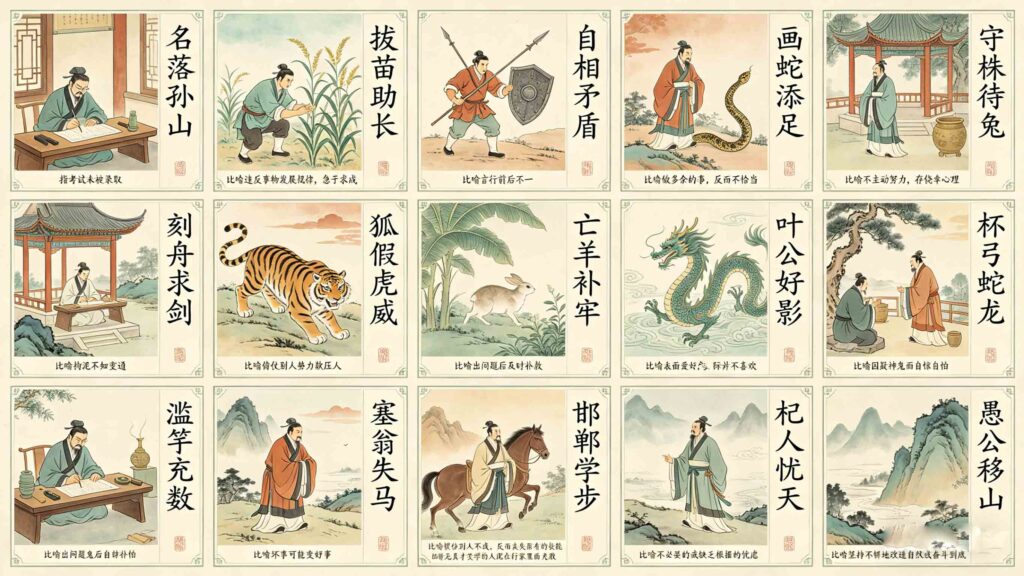
If you’re learning Chinese, you’ve probably hit a common wall.
You see short phrases everywhere, but their literal translations make no sense.
These are chinese chengyu stories — the 4-character idioms that are the heart of Chinese language and culture.
Most resources skip the stories, leaving you confused about what they mean or how to use them.
That’s the biggest pain point for learners.
Today, we’ll share 15 essential chinese chengyu stories.
Each one comes with a simple tale, clear meaning, and real-life usage.
No complex jargon, no confusing translations — just easy, actionable learning.
What Are Chinese Chengyu Stories?
Chinese chengyu stories are the tales behind traditional Chinese 4-character idioms, called chengyu.
Every chengyu has a unique origin story.
Most come from ancient fables, history, or classic literature.
Native speakers use chengyu daily.
They add wisdom, humor, and depth to conversations, writing, and media.
For learners, understanding the story is the only way to truly master the idiom.
Without the story, you’re just memorizing random characters.
Why Learn Chinese Chengyu Stories?
Learning chinese chengyu stories is more than just vocabulary practice.
It’s a way to understand Chinese culture, history, and values.
Here’s why they’re so valuable:
- They help you understand native conversations and movies
- They make your Chinese sound fluent and natural
- They teach life lessons through engaging tales
- They boost your reading and writing skills
The biggest mistake learners make is skipping the story.
Memorizing characters without context leads to quick forgetting.
Stories stick in your mind, making idioms easy to remember and use.
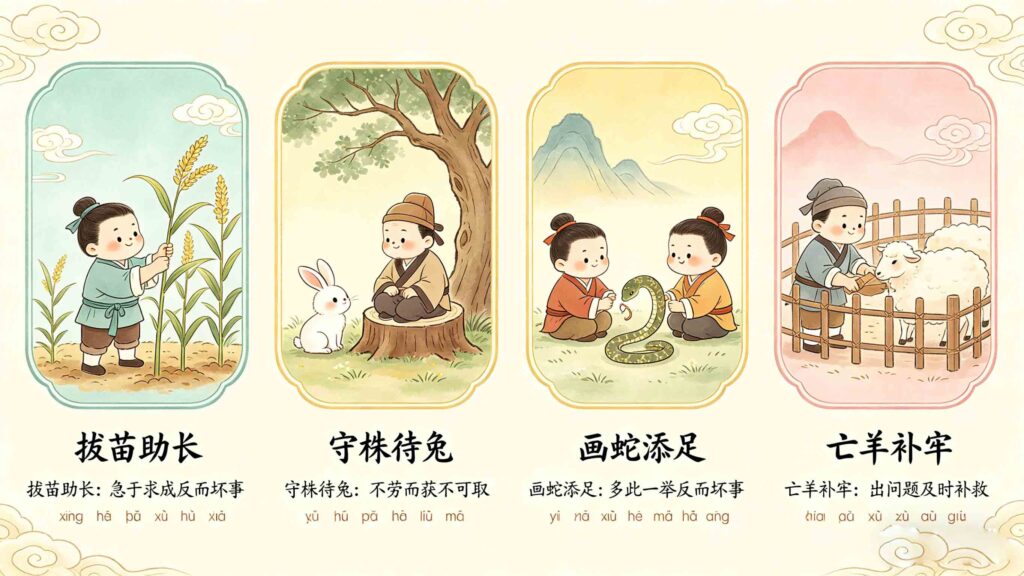
15 Essential Chinese Chengyu Stories to Learn
These are the most common, useful chengyu for beginners and intermediate learners.
1. 守株待兔 (Shǒu Zhū Dài Tù)
Story: A farmer finds a hare that ran into a tree stump and died.
He stops working to wait for more hares, but never catches another.
Meaning: Don’t rely on luck instead of hard work.
2. 狐假虎威 (Hú Jiǎ Hǔ Wēi)
Story: A fox tricks a tiger into following him.
Other animals run away from the tiger, not the fox.
The fox thinks he’s the powerful one.
Meaning: Using someone else’s power to bully others.
3. 画蛇添足 (Huà Shé Tiān Zú)
Story: A man wins a wine pot by drawing a snake first.
He adds feet to the snake to show off, and loses the pot.
Meaning: Doing something unnecessary that ruins the result.
4. 愚公移山 (Yú Gōng Yí Shān)
Story: An old man decides to dig away two mountains blocking his home.
He works every day, and the gods move the mountains for him.
Meaning: Persistence can overcome any obstacle.
5. 掩耳盗铃 (Yǎn ěr Dào Líng)
Story: A man steals a bell and covers his own ears.
He thinks no one else can hear it ring.
Meaning: Deceiving only yourself.
6. 亡羊补牢 (Wáng Yáng Bǔ Láo)
Story: A farmer loses sheep because his pen has a hole.
He fixes the pen after the loss, and no more sheep escape.
Meaning: It’s never too late to fix a mistake.
7. 对牛弹琴 (Duì Niú Tán Qín)
Story: A musician plays beautiful music to a cow.
The cow ignores it completely.
Meaning: Wasting effort on someone who can’t understand.
8. 刻舟求剑 (Kè Zhōu Qiú Jiàn)
Story: A man drops his sword in a river.
He carves a mark on the boat and looks for the sword later.
Meaning: Being rigid and not adapting to change.
9. 井底之蛙 (Jǐng Dǐ Zhī Wā)
Story: A frog lives in a well and thinks it’s the whole world.
A sea turtle tells him about the vast ocean.
Meaning: Having a narrow, limited perspective.
10. 卧薪尝胆 (Wò Xīn Cháng Dǎn)
Story: A king endures hardship to remember his revenge.
He works hard and eventually succeeds.
Meaning: Enduring suffering to achieve a goal.
11. 杯弓蛇影 (Bēi Gōng Shé Yǐng)
Story: A man sees a bow’s shadow in his cup.
He thinks it’s a snake and makes himself sick.
Meaning: Being suspicious and imagining things.
12. 叶公好龙 (Yè Gōng Hào Lóng)
Story: A man claims to love dragons.
He’s terrified when a real dragon visits his home.
Meaning: Pretending to like something you actually fear.
13. 黔驴技穷 (Qián Lǘ Jì Qióng)
Story: A donkey scares a tiger with brays.
The tiger soon realizes it has no real power.
Meaning: Using up all one’s limited skills.
14. 惊弓之鸟 (Jīng Gōng Zhī Niǎo)
Story: A bird that was shot before panics at a bow’s sound.
It falls from the sky without an arrow.
Meaning: Being easily frightened by past trauma.
15. 水滴石穿 (Shuǐ Dī Shí Chuān)
Story: Constant water dripping wears a hole in stone over time.
Meaning: Small, consistent effort leads to big results.
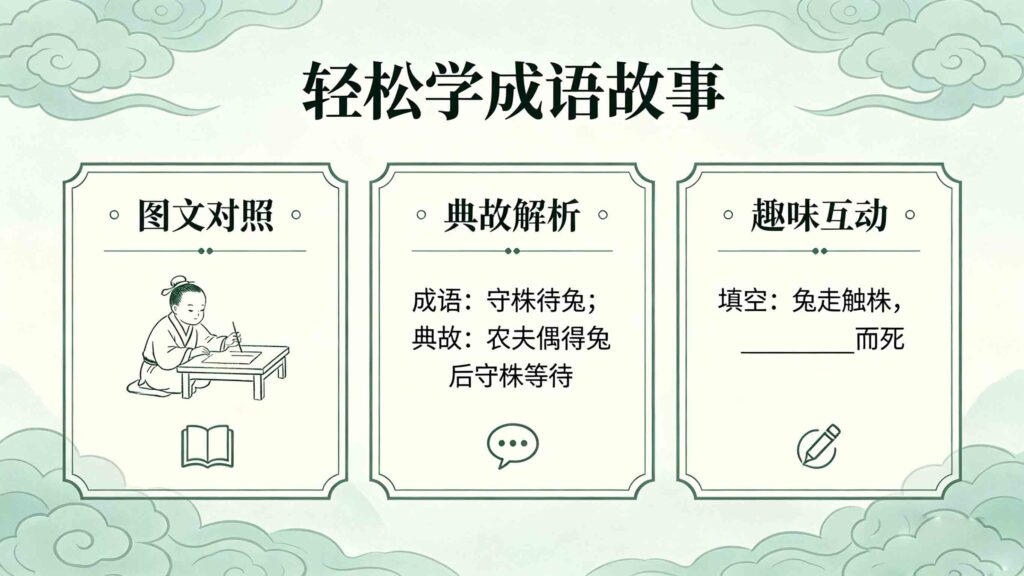
How to Learn Chinese Chengyu Stories Effectively
Learning chinese chengyu stories doesn’t have to be hard.
Follow these simple steps to master them.
Step 1: Read the story first
Stories are easier to remember than definitions.
Start with the tale, then learn the chengyu.
Step 2: Understand the meaning
Don’t just memorize characters.
Know what the idiom means and when to use it.
Step 3: Practice with example sentences
Use the idiom in real sentences.
Start simple, then use it in conversations.
Step 4: Review regularly
Review 2-3 chengyu per week.
Repetition is key to long-term memory.
Step 5: Use printable resources
Print out chengyu stories or flashcards.
Having a physical copy makes review easy anytime, anywhere.
Who Should Learn These Chengyu Stories?
These chinese chengyu stories are perfect for:
- Beginner and intermediate Chinese learners
- Parents teaching kids Chinese culture
- Teachers looking for classroom materials
- Anyone who loves Chinese history and culture
They’re simple enough for kids, but useful enough for adult learners.
No matter your level, these stories will improve your Chinese.
Frequently Asked Questions (FAQ)
Q1: What are chinese chengyu stories?
A: Chinese chengyu stories are the origin tales behind traditional Chinese 4-character idioms (chengyu).
Each story explains the meaning and usage of the idiom, making it easy to learn.
Q2: Why are chengyu stories important for learners?
A: Stories help you remember idioms far better than memorizing characters alone.
They also teach you Chinese culture, history, and values.
Mastering stories is the key to using chengyu correctly.
Q3: How many chengyu stories should a beginner learn?
A: Start with 15-20 common, easy-to-understand stories first.
Quality is more important than quantity.
Master these before moving to more complex ones.
Q4: Are these chengyu stories suitable for kids?
A: Yes. Many have simple, moral stories that are perfect for children.
They’re a fun way to teach kids Chinese language and culture.
Q5: Can I use these chengyu in daily conversation?
A: Definitely. Native speakers use these common chengyu every day.
Using them properly makes you sound more fluent and natural.
Final Thoughts
Chinese chengyu stories are a beautiful, valuable part of Chinese language and culture.
With simple tales and clear meanings, anyone can learn and master them.
These 15 stories are the foundation for any learner.
Once you master them, you’ll notice a huge difference in your understanding of Chinese.
You’ll be able to follow conversations, understand movies, and speak more naturally.
Learning chengyu is a journey, not a race.
Take it one story at a time, and you’ll make steady progress.
Before you know it, you’ll be using these idioms like a native speaker.
To learn more about the history and cultural significance of chengyu, you can visit the Wikipedia page for Chengyu.
If you enjoy these interesting tales, you may also love our specially curated collection: 10 Animal Chinese Chengyu Stories PDF. It includes vivid stories and simple explanations to make learning Chinese idioms even more fun.