If you’re learning Chinese, you’ve probably noticed that animals are everywhere in chengyu. Among them, rabbit chinese idioms are some of the most vivid and widely used—but they’re often confusing for learners.
The biggest pain point? Most resources just list the characters without simple explanations or real-life usage. You memorize the words, but you don’t know when to use them.
Today, we’ll break down 6 essential rabbit chinese idioms. We’ll explain each one with a clear meaning, origin (when relevant), and easy-to-understand examples. No complex jargon, no confusing translations—just practical learning to help you use these idioms naturally.
What Are Rabbit Chinese Idioms?
Rabbit chinese idioms are traditional four-character chengyu that feature rabbits (called “tu” in Chinese) as the core image. Rabbits have long been a symbol in Chinese culture—representing agility, luck, and sometimes timidity.
These idioms come from ancient fables, folk stories, and even daily observations of rabbits’ behavior. They’re used in daily conversation, writing, and media, making them a key part of mastering Chinese.
For learners, understandingrabbit chinese idioms isn’t just about expanding vocabulary—it’s about grasping the cultural context behind the phrases. This helps you sound more fluent and connect with native speakers on a deeper level.
Why Learn Rabbit Chinese Idioms?
You might wonder: Why focus on rabbit-specific chengyu? Here’s why they’re worth learning:
First, they’re common in daily life. Native speakers use rabbit chinese idioms to describe people, situations, and emotions—from someone’s quick movements to a lucky opportunity.
Second, they’re easy to remember. The rabbit image is familiar and relatable, so the stories and meanings stick in your mind faster than abstract idioms.
Third, they boost your cultural understanding. Rabbits are tied to Chinese traditions (like the Moon Rabbit in Mid-Autumn Festival), so learning these idioms teaches you more about Chinese culture while you learn the language.
Finally, they make your Chinese more expressive. Using rabbit chinese idioms correctly helps you avoid plain language and sound more natural, whether you’re speaking or writing.
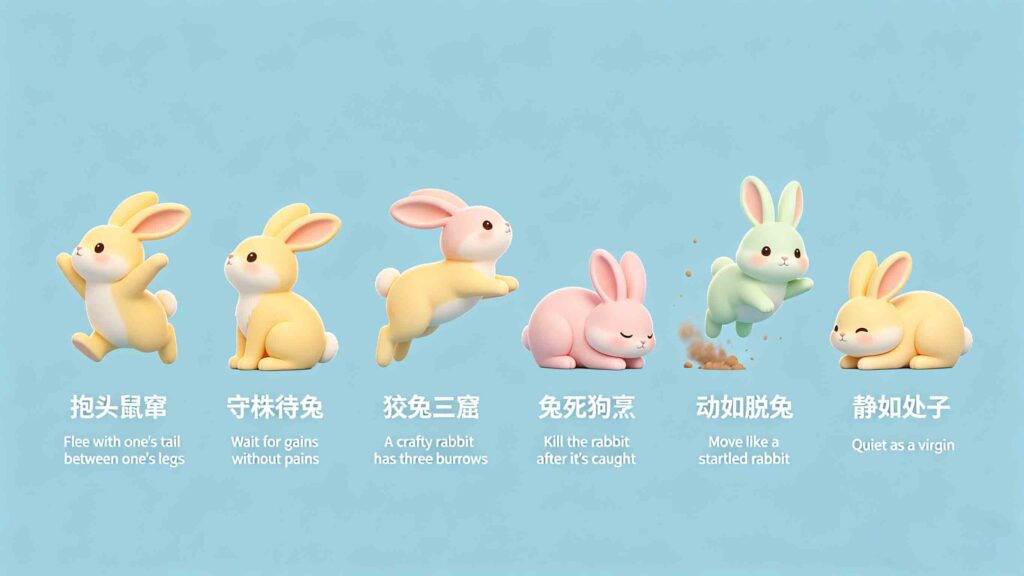
6 Essential Rabbit Chinese Idioms (With Meanings & Examples)
We’ve selected 6 of the most useful rabbit chinese idioms. Each one includes a simple meaning, origin (when it adds value), and practical example—so you can start using them right away.
1. 守株待兔 (Shǒu Zhū Dài Tù)
Meaning: To wait for luck instead of working hard; to rely on chance rather than effort.
Origin: A classic fable about a farmer who finds a hare that runs into a tree stump and dies. He stops working to wait for more hares to hit the stump, but he never catches another.
Example: Don’t just wait for a promotion—work hard for it. Waiting around is like 守株待兔 (shǒu zhū dài tù).
2. 狡兔三窟 (Jiǎo Tù Sān Kū)
Meaning: A clever person has multiple plans or safe places to fall back on; to be prepared for all possibilities.
Origin: From the ancient Chinese text “Zuo Zhuan.” It describes a rabbit digging three burrows to avoid being caught, symbolizing caution and preparation.
Example: She has a full-time job, a side hustle, and savings—she’s really 狡兔三窟 (jiǎo tù sān kū) and never worries about money.
3. 兔死狐悲 (Tù Sǐ Hú Bēi)
Meaning: To feel sad for someone who is in the same situation as you; sympathy for a fellow sufferer (literally, “the fox grieves when the rabbit dies”).
Origin: The fox and rabbit are both hunted animals. If the rabbit dies, the fox realizes it could be next—so it grieves not just for the rabbit, but for itself.
Example: When his colleague got fired, he felt 兔死狐悲 (tù sǐ hú bēi)—he knew he could be next if he didn’t work harder.
4. 兔走乌飞 (Tù Zǒu Wū Fēi)
Meaning: Time passes quickly (literally, “the rabbit runs and the crow flies”; the rabbit refers to the Moon Rabbit, and the crow refers to the Sun Crow in Chinese mythology).
Example: It’s hard to believe a year has passed—兔走乌飞 (tù zǒu wū fēi), and we’re already in spring again.
5. 动如脱兔 (Dòng Rú Tuō Tù)
Meaning: To move as fast and agile as a rabbit; to be quick and nimble.
Origin: From the “Book of Rites,” describing someone who is calm when at rest but quick when moving—like a rabbit that escapes quickly.
Example: When the fire alarm rang, everyone ran out 动如脱兔 (dòng rú tuō tù) to safety.
6. 兔死狗烹 (Tù Sǐ Gǒu Pēng)
Meaning: To discard someone once they are no longer useful (literally, “the rabbit is dead, so the dog is boiled”).
Origin: From ancient history—after a king defeated his enemies with the help of his generals, he killed them because he no longer needed their help.
Example: He helped his boss start the company, but once it succeeded, he was fired—It’s a classic case of 兔死狗烹 (tù sǐ gǒu pēng).
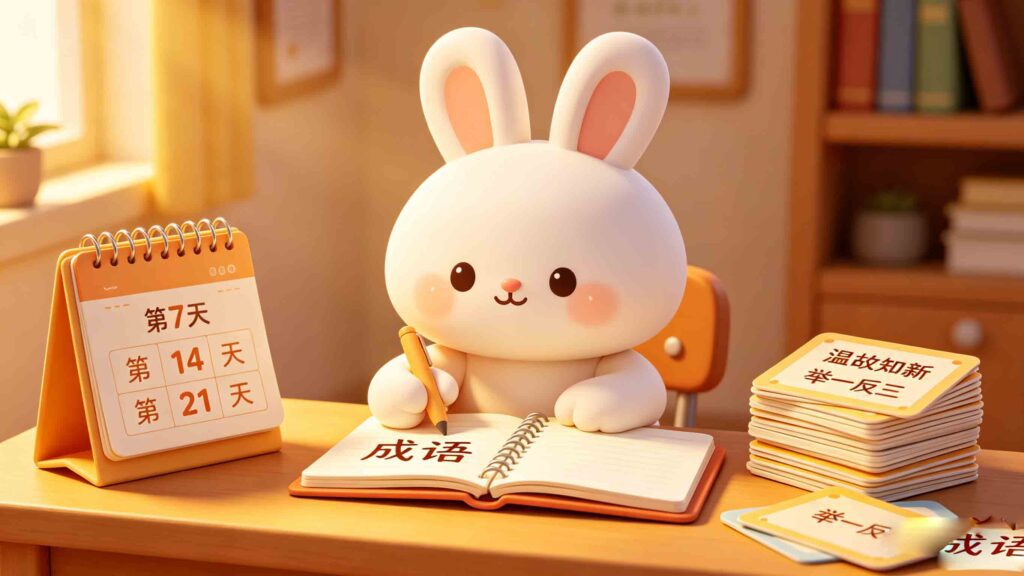
How to Learn Rabbit Chinese Idioms Effectively
Learning rabbit chinese idioms is easy if you follow these simple steps—no random memorization required:
Step 1: Learn the meaning first, not just characters
Don’t waste time memorizing characters without understanding what the idiom means. Start with the simple meaning, then learn the characters.
Step 2: Connect it to the rabbit’s traits
Most rabbit chinese idioms relate to a rabbit’s behavior—agility, speed, or caution. Linking the idiom to the rabbit’s traits helps you remember it faster.
Step 3: Practice with short examples
Use each idiom in a simple sentence (like the examples above). Practice saying or writing it once a day—this makes it easier to use in real life.
Step 4: Review regularly
Review 1-2 idioms per week. Write them down in a notebook or phone note, and glance at them when you have free time. Repetition is key to long-term memory.
Step 5: Notice them in real life
Pay attention to rabbit chinese idioms in movies, conversations, or articles. When you hear or see one, take a moment to recall its meaning—this reinforces your learning.
Who Should Learn These Rabbit Chinese Idioms?
These rabbit chinese idioms are perfect for:
– Beginner and intermediate Chinese learners (simple, common, easy to use)
– Anyone interested in Chinese culture (tied to fables, history, and traditions)
– Parents teaching kids Chinese (the rabbit image is kid-friendly and fun)
– Teachers looking for engaging classroom materials (stories and examples are easy to explain)
No matter your level, these idioms will help you improve your Chinese and connect with the language on a deeper level.

Frequently Asked Questions (FAQ)
Q1: What are rabbit chinese idioms?
A: Rabbit chinese idioms are traditional four-character chengyu that feature rabbits as the core image. They come from fables, history, and folk stories, and are used to describe people, situations, and emotions.
Q2: Are rabbit chinese idioms common in daily life?
A: Yes! Many rabbit chinese idioms (like 守株待兔、动如脱兔) are used regularly by native speakers. They’re perfect for daily conversation, writing, and even casual talks.
Q3: Do I need to know the origin of each idiom?
A: Not necessarily, but knowing the origin helps you remember the meaning better. We included simple origins for the most common ones to make learning easier.
Q4: Can beginners use these rabbit chinese idioms?
A: Absolutely! We chose 6 of the simplest, most common rabbit chinese idioms with easy meanings and examples. Beginners can start using them right away.
Q5: How many rabbit chinese idioms are there?
A: There are dozens of rabbit chinese idioms, but we focused on the 6 most useful ones for learners. Master these first, then you can expand to more complex ones.
Final Thoughts
Rabbit chinese idioms are a fun, practical way to improve your Chinese and learn more about Chinese culture. They’re easy to remember, widely used, and add depth to your language.
With the 6 idioms we’ve shared—along with their meanings and examples—you can start using them in daily life right away.
Remember: learning idioms is a journey, not a race. Take it one idiom at a time, practice regularly, and you’ll be using them like a native speaker in no time.
If you love these fun animal-themed idioms, don’t miss our curated 10 animal chinese idiom stories PDF pack for more vivid tales and simple explanations.
To learn more about the history and cultural significance of Chinese chengyu (including rabbit chinese idioms), you can visit the Wikipedia page for Chengyu.