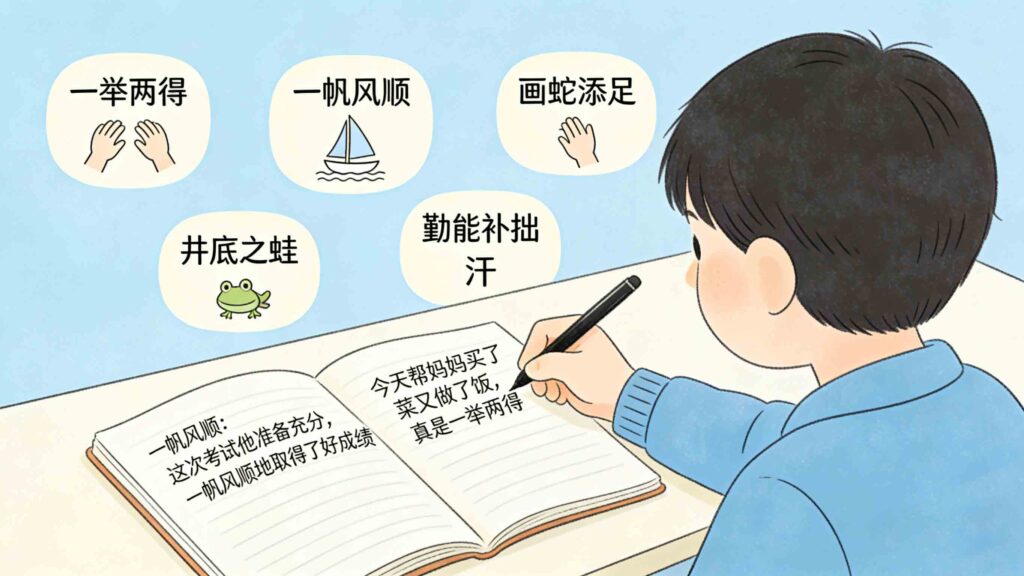
Introduction
Chinese idioms (chéngyǔ, 成语) are the soul of the language, but many learners struggle to use them naturally in sentences. Mastering Chinese idioms in sentences isn’t just about memorization—it’s about understanding context, tone, and cultural nuance.
In this guide, we’ll break down how to use common chengyu in real sentences, with clear examples, tips, and strategies to help you communicate fluently.
Why Using chengyu in Sentences Matters
Chinese idioms aren’t just “fancy words”—they’re essential for sounding natural. Native speakers use idioms in daily conversations, social media, and formal writing to convey complex ideas concisely. When you use these idioms in sentences correctly, you:
·Sound more fluent and confident
·Avoid miscommunication
·Connect with Chinese culture on a deeper level
·Make your writing and speech more engaging
Without practice, even common idioms can feel awkward. But with the right approach, you’ll be using Chinese idioms in sentences like a pro in no time.
5 Common Chinese Idioms in Sentences (With Examples)
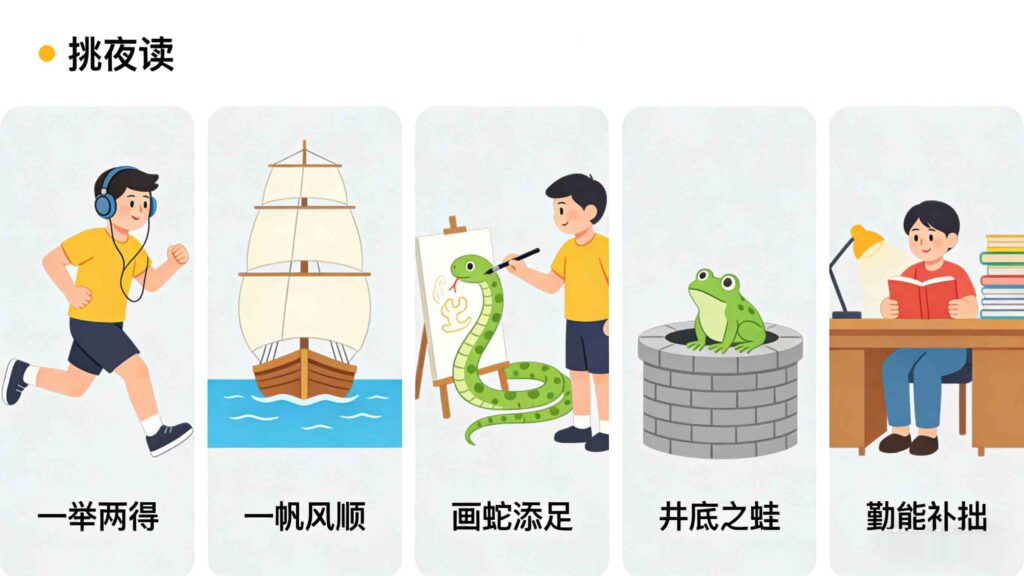
Let’s start with the most useful idioms for everyday use. Each example includes the idiom, Pinyin, meaning, and a natural sentence to show how it works.
1. 一举两得 (yī jǔ liǎng dé)
Meaning: Kill two birds with one stone
Example sentence:
我每天早上跑步,既能锻炼身体,又能听播客,真是一举两得。
(Wǒ měitiān zǎoshang pǎobù, jì néng duànliàn shēntǐ, yòu néng tīng bōkè, zhēn shì yī jǔ liǎng dé.)
English translation: I run every morning—I can exercise and listen to podcasts at the same time; it’s killing two birds with one stone.
2. 一帆风顺 (yī fān fēng shùn)
Meaning: Plain sailing / Go smoothly
Example sentence:
祝你新工作一帆风顺!
(Zhù nǐ xīn gōngzuò yī fān fēng shùn!)
English translation: I wish you smooth sailing in your new job!
3. 画蛇添足 (huà shé tiān zú)
Meaning: To do something unnecessary that ruins the effect
Example sentence:
这个设计已经很好了,再加装饰就是画蛇添足。
(Zhège shèjì yǐjīng hěn hǎo le, zài jiā zhuāngshì jiù shì huà shé tiān zú.)
English translation: This design is already great—adding more decorations would be gilding the lily.
4. 井底之蛙 (jǐng dǐ zhī wā)
Meaning: A person with narrow vision
Example sentence:
多旅行,多读书,别做井底之蛙。
(Duō lǚxíng, duō dúshū, bié zuò jǐng dǐ zhī wā.)
English translation: Travel more, read more—don’t be a frog in a well.
5. 勤能补拙 (qín néng bǔ zhuō)
Meaning: Hard work makes up for lack of talent
Example sentence:
我虽然不聪明,但我相信勤能补拙。
(Wǒ suīrán bù cōngming, dàn wǒ xiāngxìn qín néng bǔ zhuō.)
English translation: I’m not the smartest, but I believe hard work can make up for it.
How to Use Chinese Idioms in Sentences: 3 Key Rules
Using Chinese idioms in sentences correctly requires more than just memorization. Follow these rules to avoid common mistakes:
1. Match the Tone
Some idioms are formal (e.g., 一帆风顺), while others are casual (e.g., 画蛇添足). Use formal idioms in emails or speeches, and casual ones in conversations with friends.
2. Don’t Overuse
Native speakers use 1-2 idioms per conversation. Overusing them sounds unnatural and forced. Stick to one idiom per paragraph or sentence.
3. Learn the Context
Idioms often have cultural or historical roots. For example, 卧薪尝胆 (wò xīn cháng dǎn) comes from a story about perseverance. Understanding the context helps you use it appropriately.
Practice Makes Perfect: Exercises for Using Chinese Idioms in Sentences
The best way to master Chinese idioms in sentences is to practice. Try these simple exercises:
1、Rewrite a sentence: Take a simple sentence (e.g., “I worked hard and succeeded”) and rewrite it using an idiom (e.g., “勤能补拙,我终于成功了”).
2、Create your own examples: For each idiom you learn, write 1-2 original sentences in both Chinese and English.
3、Talk to native speakers: Practice using idioms with Chinese friends or language partners—they’ll correct you and help you sound natural.
Final Tips for Mastering Chinese Idioms in Sentences
·Start small: Focus on 5-10 common idioms first, then add more as you progress.
·Use flashcards: Apps like Quizlet let you create flashcards with idioms, examples, and meanings for quick reviews.
·Be patient: It’s normal to forget idioms at first—keep practicing, and you’ll get better.
Using Chinese idioms in sentences is a fun and rewarding way to improve your Chinese. With these examples, rules, and exercises, you’ll be using chengyu like a native speaker in no time. Start practicing today, and soon you’ll be able to express yourself more fluently and confidently.
To learn more about the history and cultural background of Chinese idioms (chéngyǔ), you can refer to the Wikipedia page on Chengyu, which provides a detailed introduction to their origins and usage.
If you want to build a solid foundation before diving into sentence usage, our comprehensive guide on How to Learn Chinese Idioms offers step-by-step strategies and beginner-friendly tips to help you master chengyu more effectively