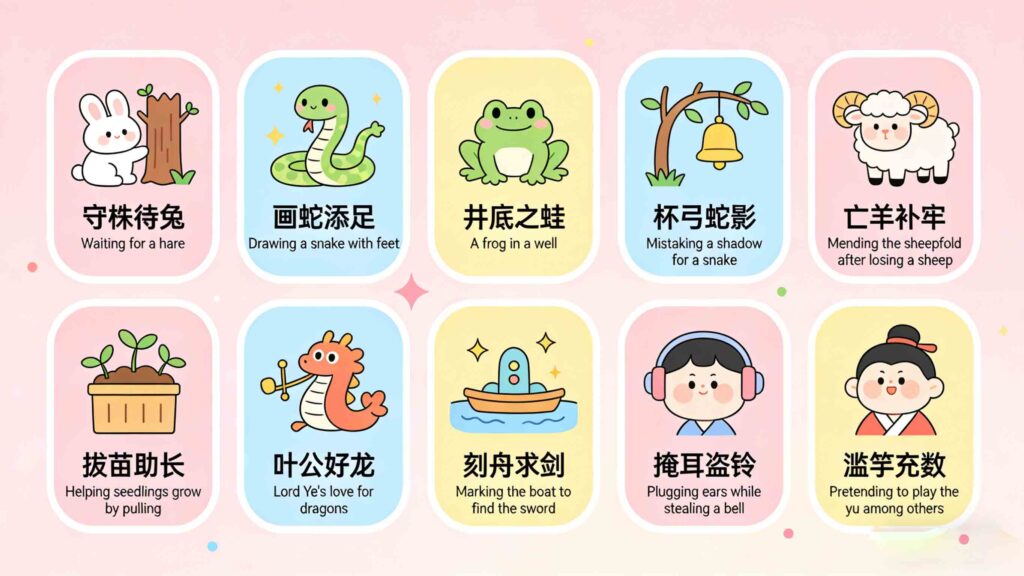
Introduction
Learning common chinese idioms in english is essential for sounding natural in Chinese conversations—and avoiding awkward misunderstandings. For foreign learners, idioms can feel tricky (many have historical roots!), so this guide breaks down 10 of the most common phrases with accurate translations, plus practical tips to help you use them correctly, not just memorize them.
Each entry includes Chinese characters, Pinyin, literal and natural English equivalents, real-life examples, and learner-focused advice (like common mistakes to avoid and how to remember them easily). Whether you’re a beginner or intermediate learner, this guide will help you communicate more fluently.
Why This Guide Is Different for Foreign Learners
As a foreign learner, you don’t just need translations—you need to use idioms naturally. Chinese idioms (called chéngyǔ, 成语) are rarely used in formal writing or casual chats randomly; they have specific scenarios. We’ll tell you: when to use each idiom, what mistakes foreigners often make, and how to fit them into your conversations without sounding awkward.
10 Common Chinese Idioms in English (For Foreign Learners)
We’ve picked idioms you’ll actually hear in daily life (not rare ancient ones!). Each entry has extra learning tips just for you.
1. 一举两得 (yī jǔ liǎng dé)
Literal Translation: One action, two gains.
Chinese Idioms to English Equivalent: Kill two birds with one stone.
Example (Chinese): 我每天早上跑步,既能锻炼身体,又能听播客,真是一举两得。(Wǒ měitiān zǎoshang pǎobù, jì néng duànliàn shēntǐ, yòu néng tīng bōkè, zhēn shì yī jǔ liǎng dé.)
Example (English): I run every morning—I can exercise and listen to podcasts at the same time; it’s killing two birds with one stone.
Learner Tip: This is one of the easiest idioms for foreigners! Use it when one action solves two problems (e.g., studying while drinking coffee). No mistake here—everyone uses it casually!

2. 一帆风顺 (yī fān fēng shùn)
Literal Translation: Smooth sailing.
Chinese Idioms to English Equivalent: Plain sailing / Go smoothly.
Example (Chinese): 希望他这次面试一帆风顺,能拿到心仪的工作。(Xīwàng tā zhècì miànshì yī fān fēng shùn, néng ná dào xīnyí de gōngzuò.)
Example (English): I hope his interview goes smoothly and he gets the job he wants.
Learner Tip: Use this to wish someone luck (for exams, trips, jobs). Mistake to avoid: Don’t use it for past events (e.g., “My trip was 一帆风顺” is okay, but better to say “My trip went smoothly”).
3. 兴高采烈 (xìng gāo cǎi liè)
Literal Translation: High spirits and bright complexion.
Chinese Idioms to English Equivalent: Be over the moon / Be in high spirits.
Example (Chinese): 孩子们收到礼物后,都兴高采烈地跳了起来。(Háizimen shōudào lǐwù hòu, dōu xìng gāo cǎi liè de tiào le qǐlái.)
Example (English): After receiving the gifts, the children all jumped up in high spirits.
Learner Tip: This is more vivid than “happy”! Use it for big joys (e.g., getting a job, seeing a friend). Bonus: It’s formal and casual—safe for all situations.
4. 闷闷不乐 (mèn mèn bù lè)
Literal Translation: Gloomy and not happy.
Chinese Idioms to English Equivalent: Be in the doldrums / Be down in the dumps.
Example (Chinese): 他因为考试没考好,一整天都闷闷不乐的。(Tā yīnwèi kǎoshì méi kǎo hǎo, yī zhěng tiān dōu mèn mèn bù lè de.)
Example (English): He was down in the dumps all day because he didn’t do well in the exam.
Learner Tip: Use this for quiet, long-lasting sadness (not anger). Mistake to avoid: Don’t mix it with “生气” (angry)—they’re different!
5. 肝胆相照 (gān dǎn xiāng zhào)
Literal Translation: Liver and gallbladder shine together.
Chinese Idioms to English Equivalent: Be open and honest with each other / Have complete trust.
Example (Chinese): 我和他是多年的好朋友,我们之间一直肝胆相照。(Wǒ hé tā shì duō nián de hǎo péngyǒu, wǒmen zhījiān yìzhí gān dǎn xiāng zhào.)
Example (English): He and I have been good friends for many years, and we have complete trust in each other.
Learner Tip: This is for close friendships/relationships (not casual acquaintances). Chinese people use it to show loyalty—great to use with good friends!
6. 勤能补拙 (qín néng bǔ zhuō)
Literal Translation: Diligence can make up for clumsiness.
Chinese Idioms to English Equivalent: Hard work makes up for lack of talent.
Example (Chinese): 他虽然不算聪明,但他知道勤能补拙,每天都努力学习。(Tā suīrán bù suàn cōngmíng, dàn tā zhīdào qín néng bǔ zhuō, měitiān dōu nǔlì xuéxí.)
Example (English): Although he is not very smart, he knows that hard work makes up for lack of talent and studies hard every day.
Learner Tip: Perfect for encouraging yourself or others (e.g., when learning Chinese!). It’s a positive, common idiom—Chinese parents often say this to kids!
7. 知错能改 (zhī cuò néng gǎi)
Literal Translation: Know the mistake and can correct it.
Chinese Idioms to English Equivalent: Admit and correct one’s mistake.
Example (Chinese): 每个人都会犯错,知错能改就是好孩子。(Měi ge rén dōu huì fàn cuò, zhī cuò néng gǎi jiù shì hǎo háizi.)
Example (English): Everyone makes mistakes; admitting and correcting them makes you a good person.
Learner Tip: Use this when someone apologizes or corrects a mistake. It’s polite and kind—great for daily interactions.
8. 井底之蛙 (jǐng dǐ zhī wā)
Literal Translation: Frog at the bottom of a well.
Chinese Idioms to English Equivalent: A person with a narrow vision.
Example (Chinese): 他从来不出远门,就像一只井底之蛙,不知道外面的世界有多大。(Tā cónglái bù chū yuǎnmén, jiù xiàng yī zhī jǐng dǐ zhī wā, bù zhīdào wàimiàn de shìjiè yǒu duō dà.)
Example (English): He never travels far; he’s like a frog at the bottom of a well, not knowing how big the outside world is.
Learner Tip:Important: This is slightly negative (not rude, but don’t use it for people directly!). Use it to describe someone who lacks experience/knowledge (e.g., “I was a 井底之蛙 before I traveled to China”).
9. 同舟共济 (tóng zhōu gòng jì)
Literal Translation: Cross the river in the same boat.
Chinese Idioms to English Equivalent: Pull together through thick and thin.
Example (Chinese): 在困难的时候,我们应该同舟共济,一起度过难关。(Zài kùnnan de shíhou, wǒmen yīnggāi tóng zhōu gòng jì, yīqǐ dùguò nánguān.)
Example (English): In difficult times, we should pull together through thick and thin.
Learner Tip: Use this for groups (friends, colleagues, family) facing a problem. It’s a warm, encouraging idiom—great for team situations.
10. 马到成功 (mǎ dào chéng gōng)
Literal Translation: Horse arrives, success comes.
Chinese Idioms to English Equivalent: Success at first try / Instant success.
Example (Chinese): 祝你这次项目马到成功,顺利完成所有任务。(Zhù nǐ zhècì xiàngmù mǎ dào chéng gōng, shùnlì wánchéng suǒyǒu rènwù.)
Example (English): Wish you instant success on this project and smooth completion of all tasks.
Learner Tip: This is a popular “good luck” idiom (especially for work/studies). It’s more energetic than “一帆风顺”—use it when you want to wish someone quick success.
Key Tips for Foreign Learners (Must-Read!)
To use these Chinese idioms confidently, remember these 3 simple rules:
1. Don’t use idioms too often: Chinese people use 1-2 idioms per conversation, not every sentence. Overusing them will sound unnatural.
2. Pay attention to tone: A few idioms (like 井底之蛙) are slightly negative—use them carefully (never to insult someone).
3. Memorize with examples: Instead of just memorizing the translation, remember the example sentence—this helps you use the idiom in the right context.
Final Thoughts for You
These 10 Chinese idioms in English translations are perfect for daily use—you’ll hear them in chats, movies, and even from your Chinese friends! The extra learner tips are designed to help you use them, not just memorize them.
Learning idioms is a great way to sound more natural in Chinese and understand Chinese culture better. Take it slow: pick 1-2 idioms per week, practice the example sentences, and you’ll be using them confidently in no time!
If you want a more complete collection, check out our Chinese Idioms List
For more on Chinese idiom culture, visit Wikipedia’s page on Chengyu
These common Chinese idioms in English will help you communicate more fluently in daily life.