Introduction
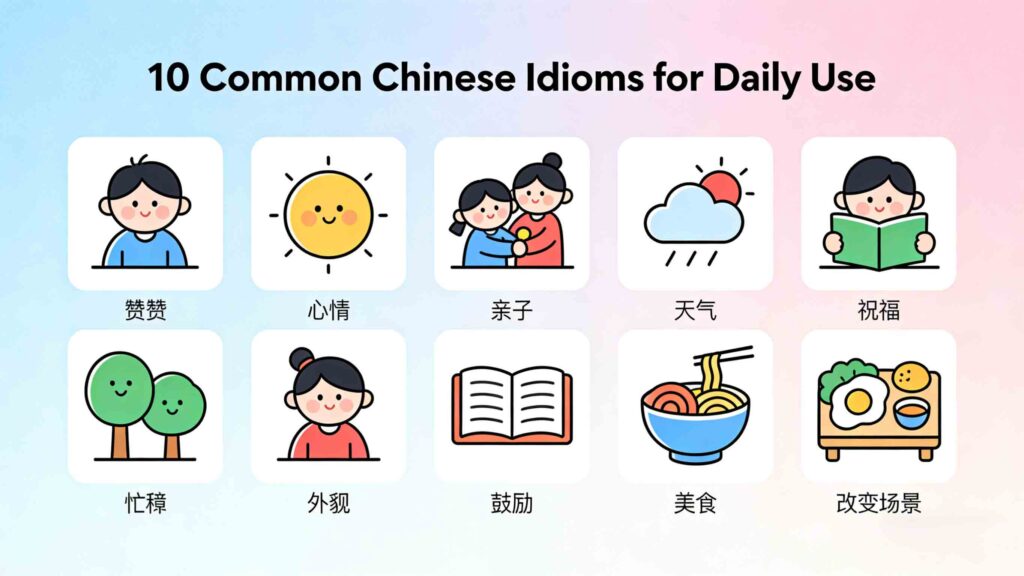
Learning 100 Chinese idioms at once can feel overwhelming. Instead, this Chinese idioms list breaks down 50 of the most useful common Chinese idioms for daily use into 10 everyday scenarios, paired with simple memory hacks to help you use them fluently in your conversations.
1. Daily Compliments: From Our Chinese Idioms List
These are some of the most practical Common Chinese Idioms for Daily Use for giving compliments.
In casual conversations, a well-chosen idiom can make your praise feel more vivid and sincere. Here are 5 go-to idioms for complimenting others.
赞不绝口 (zàn bù jué kǒu): To praise someone endlessly, showing great satisfaction. Memory Hack: Think “赞” (praise) + “不绝” (non-stop) = non-stop praise. Example: Everyone was 赞不绝口 about your cooking at the party!
出类拔萃 (chū lèi bá cuì): To stand out from the crowd and be exceptional. Memory Hack: “出类” (exit the group) + “拔萃” (pull out the best) = the best of the best. Example: Her presentation skills are 出类拔萃 —she always impresses the team.
冰雪聪明 (bīng xuě cōng míng): Extremely intelligent, as clear and sharp as ice and snow. Memory Hack: “冰雪” (ice and snow) + “聪明” (smart) = sharp as ice. Example: My niece is 冰雪聪明 —she solves math problems faster than me!
能说会道 (néng shuō huì dào): Eloquent and skilled at communication. Memory Hack: “能说” (can speak) + “会道” (can converse) = a great talker. Example: He’s 能说会道 —he can convince anyone to agree with him.
心灵手巧 (xīn líng shǒu qiǎo): Quick-witted and skillful with one’s hands. Memory Hack: “心灵” (clever mind) + “手巧” (skillful hands) = clever and crafty. Example: She’s 心灵手巧 —she made all these decorations herself.
2. Describing Feelings: Essential Chinese Idioms
Idioms are a powerful way to express emotions with more depth. These 5 idioms will help you talk about how you or others feel.
喜出望外 (xǐ chū wàng wài): To be pleasantly surprised by an unexpected joy. Memory Hack: “喜” (joy) + “出望外” (beyond expectation) = joy beyond what you hoped for. Example: I was 喜出望外 when my friend showed up with my favorite coffee.
闷闷不乐 (mèn mèn bù lè): To feel down and unhappy, without showing it openly. Memory Hack: “闷闷” (gloomy) + “不乐” (not happy) = quietly sad. Example: He’s been 闷闷不乐 since he lost his phone.
心急如焚 (xīn jí rú fén): To be extremely anxious, as if your heart is on fire. Memory Hack: “心急” (heart anxious) + “如焚” (like fire) = burning with worry. Example: I was 心急如焚 waiting for the test results.
忧心忡忡 (yōu xīn chōng chōng): To be filled with worry and anxiety. Memory Hack: “忧心” (worried heart) + “忡忡” (restless) = deeply worried. Example: Parents are 忧心忡忡 about their children’s safety.
心花怒放 (xīn huā nù fàng): To be overjoyed, as if flowers are blooming in your heart. Memory Hack: “心花” (heart flowers) + “怒放” (bloom wildly) = bursting with happiness. Example: She was 心花怒放 when she got the job offer.
3. Parent-Child Interaction: Top Chinese Idioms for Daily Life
These idioms are perfect for talking about parenting and raising children, or describing how kids learn and grow.
言传身教 (yán chuán shēn jiào): To teach through both words and actions, setting an example. Memory Hack: “言传” (teach with words) + “身教” (teach with actions) = lead by example. Example: Good parents 言传身教 —they show their kids how to be kind.
耳濡目染 (ěr rú mù rǎn): To be influenced gradually by what you hear and see. Memory Hack: “耳濡” (ears soak in) + “目染” (eyes absorb) = learn by exposure. Example: Growing up in a musical family, he 耳濡目染 and became a great pianist.
因材施教 (yīn cái shī jiào): To teach according to each student’s unique strengths and needs. Memory Hack: “因材” (based on talent) + “施教” (teach accordingly) = personalized teaching. Example: Great teachers 因材施教 —they help every student reach their potential.
循循善诱 (xún xún shàn yòu): To guide someone patiently and skillfully toward understanding. Memory Hack: “循循” (step by step) + “善诱” (good at guiding) = gentle guidance. Example: The tutor 循循善诱 —she never gets frustrated when I ask questions.
寓教于乐 (yù jiào yú lè): To blend education with fun, so learning feels like play. Memory Hack: “寓教” (hide teaching) + “于乐” (in fun) = learn while playing. Example: We use idiom games to make learning 寓教于乐 for the kids.
4. Describing Weather: From Our Chinese Idioms List
Use these idioms to talk about the weather in a more colorful way, instead of just saying “it’s sunny” or “it’s raining.”
晴空万里 (qíng kōng wàn lǐ): A clear, cloudless sky as far as the eye can see. Memory Hack: “晴空” (clear sky) + “万里” (ten thousand miles) = endless blue sky. Example: It’s 晴空万里 today—perfect for a hike!
倾盆大雨 (qīng pén dà yǔ): A heavy downpour, as if a basin of water is being poured from the sky. Memory Hack: “倾盆” (pour from a basin) + “大雨” (heavy rain) = pouring rain. Example: We got stuck in 倾盆大雨 on our way home.
和风细雨 (hé fēng xì yǔ): A gentle breeze and light rain, creating a peaceful atmosphere. Memory Hack: “和风” (warm wind) + “细雨” (soft rain) = calm and mild weather. Example: The garden looks fresh after the 和风细雨.
秋高气爽 (qiū gāo qì shuǎng): The crisp, cool weather of autumn, with clear skies. Memory Hack: “秋高” (autumn high) + “气爽” (air fresh) = fresh autumn air. Example: 秋高气爽 is my favorite season—great for cycling.
冰天雪地 (bīng tiān xuě dì): A world covered in ice and snow, extremely cold. Memory Hack: “冰天” (ice sky) + “雪地” (snow ground) = freezing winter landscape. Example: We went skiing in the 冰天雪地 of the mountains.
5. Sending Wishes & Greetings: Essential Chinese Idioms
These Common Chinese Idioms for Daily Use are perfect for sending warm wishes to friends and family—whether it’s a birthday, holiday, or any occasion where you want to wish someone well.
一帆风顺 (yī fān fēng shùn): To wish someone a smooth journey or a problem-free experience. Memory Hack: “一帆” (one sail) + “风顺” (wind following) = smooth sailing. Example: 祝你新的工作 一帆风顺!(Wishing you smooth sailing in your new job!)
万事如意 (wàn shì rú yì): To wish that everything goes exactly as you hope. Memory Hack: “万事” (ten thousand things) + “如意” (as you wish) = all your dreams come true. Example: Happy New Year— 万事如意!
马到成功 (mǎ dào chéng gōng): To wish someone immediate success, as soon as they start a task. Memory Hack: “马到” (horse arrives) + “成功” (success) = success right away. Example: Good luck with your presentation— 马到成功!
步步高升 (bù bù gāo shēng): To wish someone steady progress and promotion in their career. Memory Hack: “步步” (step by step) + “高升” (rise higher) = climb the ladder of success. Example: Congratulations on your promotion— 步步高升!
笑口常开 (xiào kǒu cháng kāi): To wish someone a life filled with laughter and happiness. Memory Hack: “笑口” (smiling mouth) + “常开” (always open) = keep smiling! Example: Hope you 笑口常开 every day!
6. Describing Busyness: Top Chinese Idioms for Daily Life
When you’re swamped with work or tasks, these idioms will help you express how busy you are in a more vivid way.
手忙脚乱 (shǒu máng jiǎo luàn): To be in a fluster, with hands and feet moving chaotically. Memory Hack: “手忙” (hands busy) + “脚乱” (feet messy) = total chaos. Example: I was 手忙脚乱 trying to finish everything before the deadline.
废寝忘食 (fèi qǐn wàng shí): To be so focused on something that you forget to eat or sleep. Memory Hack: “废寝” (skip sleep) + “忘食” (forget food) = obsessed with work. Example: He’s been 废寝忘食 working on his new project.
夜以继日 (yè yǐ jì rì): To work day and night without stopping. Memory Hack: “夜以” (night connects) + “继日” (to day) = non-stop work. Example: The team worked 夜以继日 to launch the product on time.
争分夺秒 (zhēng fēn duó miǎo): To race against time, grabbing every minute and second. Memory Hack: “争分” (fight for minutes) + “夺秒” (seize seconds) = hurry up! Example: We’re 争分夺秒 to finish the repairs before the storm.
应接不暇 (yìng jiē bù xiá): To be overwhelmed by too many things to handle at once. Memory Hack: “应接” (respond and receive) + “不暇” (no time) = swamped. Example: The store was so busy that the staff were 应接不暇.
7. Describing Appearance: From Our Chinese Idioms List
Use these idioms to talk about how someone looks, with more detail than just “he’s tall” or “she’s pretty.”
眉清目秀 (méi qīng mù xiù): To have clear eyebrows and bright eyes, describing a clean, attractive face. Memory Hack: “眉清” (clear brows) + “目秀” (pretty eyes) = fresh and handsome. Example: The little boy has a 眉清目秀 face—everyone loves him.
亭亭玉立 (tíng tíng yù lì): To stand tall and graceful, like a jade tree (usually describing women). Memory Hack: “亭亭” (tall and elegant) + “玉立” (jade-like posture) = elegant and slim. Example: She’s 亭亭玉立 in her new dress.
相貌堂堂 (xiàng mào táng táng): To have a dignified, impressive appearance (usually describing men). Memory Hack: “相貌” (looks) + “堂堂” (grand) = a man with presence. Example: The actor is 相貌堂堂 —he’s perfect for the role.
浓眉大眼 (nóng méi dà yǎn): To have thick eyebrows and big, expressive eyes. Memory Hack: “浓眉” (thick brows) + “大眼” (big eyes) = bold and striking. Example: He has 浓眉大眼 —you can always tell what he’s thinking.
和蔼可亲 (hé ǎi kě qīn): To be warm and friendly, easy to approach. Memory Hack: “和蔼” (gentle) + “可亲” (approachable) = a kind person. Example: My grandma is 和蔼可亲 —everyone loves visiting her.
8. Encouraging Others: Essential Chinese Idioms
When someone needs a boost, these idioms will help you give them encouragement that feels more powerful than just “good luck.”
再接再厉 (zài jiē zài lì): To keep pushing forward and work even harder after a success. Memory Hack: “再接” (again continue) + “再厉” (again strive) = keep going! Example: You did great in the first round— 再接再厉 for the final!
勇往直前 (yǒng wǎng zhí qián): To move forward bravely, without fear of obstacles. Memory Hack: “勇往” (brave go) + “直前” (straight ahead) = fearless. Example: Don’t be scared— 勇往直前 and you’ll reach your goal.
百折不挠 (bǎi zhé bù náo): To never give up, even after a hundred setbacks. Memory Hack: “百折” (hundred failures) + “不挠” (not bend) = unbreakable. Example: She’s 百折不挠 —she tried 10 times before finally getting the job.
坚持不懈 (jiān chí bù xiè): To persist with determination, without letting up. Memory Hack: “坚持” (hold on) + “不懈” (not tire) = keep trying. Example: If you 坚持不懈,you’ll eventually master Chinese.
迎难而上 (yíng nán ér shàng): To face difficulties head-on and tackle them bravely. Memory Hack: “迎难” (face trouble) + “而上” (go up) = take on challenges. Example: The team 迎难而上 and solved the problem.
9. Describing Food: Top Chinese Idioms for Daily Life
Food is a big part of Chinese culture, and these idioms will help you talk about delicious meals in a more fun way.
垂涎三尺 (chuí xián sān chǐ): To drool with desire for food, as if your saliva is three feet long. Memory Hack: “垂涎” (saliva drip) + “三尺” (three feet) = extremely hungry. Example: The smell of the barbecue made me 垂涎三尺.
津津有味 (jīn jīn yǒu wèi): To eat or do something with great enjoyment and interest. Memory Hack: “津津” (delighted) + “有味” (has flavor) = savor every bite. Example: He ate the noodles 津津有味 —it must have been really good.
回味无穷 (huí wèi wú qióng): To have a lingering, unforgettable taste that stays in your mouth. Memory Hack: “回味” (aftertaste) + “无穷” (endless) = unforgettable flavor. Example: The dessert was so good—it left me 回味无穷.
香飘十里 (xiāng piāo shí lǐ): To have a fragrance that spreads for miles, describing something very aromatic. Memory Hack: “香飘” (fragrance drifts) + “十里” (ten miles) = smells amazing! Example: The bakery’s bread 香飘十里 —you can smell it from the street.
山珍海味 (shān zhēn hǎi wèi): A feast of rare and expensive delicacies from mountains and seas. Memory Hack: “山珍” (mountain treasures) + “海味” (sea flavors) = fancy feast. Example: We had a feast of 山珍海味 at the wedding.
10. Describing Change: From Our Chinese Idioms List
With these Common Chinese Idioms for Daily Use, you’ll be able to talk about changes more vividly—whether it’s a city, a relationship, or any situation that has shifted over time.
日新月异 (rì xīn yuè yì): To change and improve every day, like new days and months. Memory Hack: “日新” (daily new) + “月异” (monthly different) = constant improvement. Example: Technology is developing 日新月异 —it’s hard to keep up!
翻天覆地 (fān tiān fù dì): To undergo a complete and dramatic transformation. Memory Hack: “翻天” (flip sky) + “覆地” (turn earth) = total change. Example: The city has changed 翻天覆地 since I last visited.
焕然一新 (huàn rán yī xīn): To look completely new and fresh, like a brand new version. Memory Hack: “焕然” (bright) + “一新” (new) = fresh and modern. Example: After the renovation, the house looks 焕然一新.
今非昔比 (jīn fēi xī bǐ): To be completely different now from how it was in the past. Memory Hack: “今非” (now not) + “昔比” (past compare) = no longer the same. Example: The company is 今非昔比 —it’s now one of the biggest in the world.
瞬息万变 (shùn xī wàn biàn): To change rapidly and unpredictably in the blink of an eye. Memory Hack: “瞬息” (moment) + “万变” (ten thousand changes) = fast changes. Example: The stock market is 瞬息万变 —you have to be careful.
Master More Chinese Idioms With Our Premium Resources
Mastering Chinese idioms takes practice, and having access to structured, in-depth learning materials makes the process far faster and more effective. Our premium Chinese idiom learning package includes exclusive scenario-based practice exercises, audio pronunciations for every idiom, and one-on-one guidance to help you use idioms confidently in real conversations.
[Click Here to Explore Our Premium Chinese Idiom Learning Resources]
Want to learn more about Chinese idiom culture? Check out this comprehensive guide on Chinese idioms from Wikipedia.
Now you have 50 useful Common Chinese Idioms for Daily Use to make your conversations more fluent.