If you’re searching for hu lun tun zao mean, you’re asking about one of the most vivid Chinese idioms that describes messy, hasty work.
Hu Lun Tun Zao (囫囵吞枣) is a classic 4-character Chinese chengyu.
It’s widely used in daily conversations and written Chinese.
This guide breaks down its meaning, origin story, and practical usage.

Hu Lun Tun Zao Mean: Literal & Figurative Translation
First, let’s answer the core question: hu lun tun zao mean.
The literal translation of each character:
- 囫囵 (hú lún): whole, intact
- 吞 (tūn): swallow
- 枣 (zǎo): jujube (Chinese date)
The direct, word-for-word translation is: “swallow a jujube whole”.
But its real, figurative meaning is:
To do something hastily, carelessly, or without thinking; to accept ideas/knowledge without understanding or digesting them.
Common English equivalents:
- To swallow something whole
- To accept something uncritically
- To do a slapdash job
- To read without comprehension
- To rush through a task
The Origin Story of hu lun tun zao mean
The idiom comes from an ancient Chinese anecdote.
Long ago, there was a man who heard a doctor say:
“Eating jujubes is good for your spleen, but bad for your teeth.”
The man thought of a “smart” solution.
He said: “I’ll swallow the jujube whole!
This way, it can benefit my spleen, and my teeth won’t be hurt.”
Of course, this was a ridiculous idea.
Swallowing a jujube whole meant he couldn’t taste it, digest it, or get any nutrition from it.
The story became a metaphor for people who:
- Rush through tasks without care
- Accept knowledge without understanding
- Cut corners to avoid effort
Over time, hu lun tun zao became a widely used idiom to criticize hasty, thoughtless behavior.
How to Use “Hu Lun Tun Zao” mean in Daily Chinese
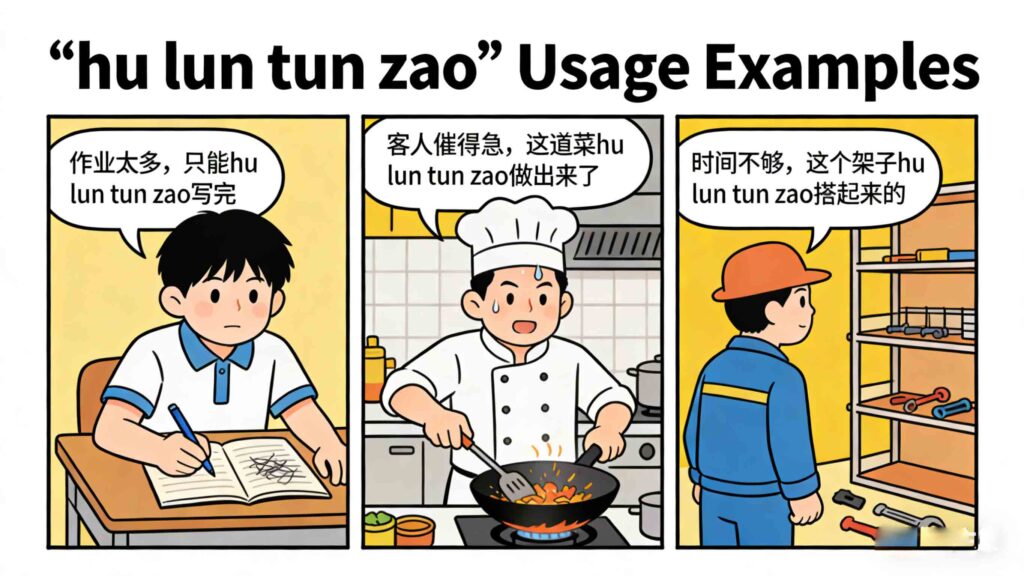
This idiom is extremely versatile.
You can use it in almost any situation where someone acts carelessly or hastily.
Here are common examples:
1. Criticize hasty work or study
- When a student rushes through homework: “Don’t hu lun tun zao! Read the questions carefully.”(不要囫囵吞枣!仔细读题。)
- When someone skims a book without understanding: “You can’t hu lun tun zao when reading academic books.”(读学术书不能囫囵吞枣。)
2. Warn against uncritical acceptance
- When someone accepts rumors blindly: “Don’t hu lun tun zao what others say. Think for yourself.”(不要囫囵吞枣别人的话,自己思考。)
- When learning new skills: “Learn step by step, don’t hu lun tun zao.”(循序渐进地学,不要囫囵吞枣。)
3. Describe messy, careless work
- When a project is done hastily: “This report is hu lun tun zao. Rewrite it carefully.”(这份报告囫囵吞枣,重新认真写。)
Synonyms & Variations of hu lun tun zao mean
Synonyms of “Hu Lun Tun Zao”
- Long Tu Da Ye (龙图大业): Careless, slapdash
- Cao Cao Luan Zhan (草草乱斩): Hasty, perfunctory
- Bu Qiu Shen Jie (不求甚解): Not seeking deep understanding
Antonyms of “Hu Lun Tun Zao”
- Yan Ge Zi Xi (严格仔细): Strict and careful
- Zi Xi Yan Jiu (仔细研究): Study carefully
- Shen Si Shu Lu (深思熟虑): Think deeply
Why “Hu Lun Tun Zao” Is an Important Chinese Idiom
this idiom is more than just a phrase.
It’s a core part of Chinese cultural values.
It emphasizes the importance of:
- Careful thinking
- Deep understanding
- Diligent work
- Critical thinking
When you use this idiom, you’re not just describing behavior.
You’re referencing a timeless lesson about the danger of hasty, thoughtless action.
Final Thoughts on “Hu Lun Tun Zao”
Now you know hu lun tun zao mean (swallow a jujube whole, do something hastily), its origin story, and how to use it naturally.
Whether you’re learning Mandarin, reading Chinese literature, or talking with Chinese friends, this idiom is a must-know.
If you love learning Chinese idioms, check out our collection of Fun Chinese Idiom Stories with vivid backgrounds and easy explanations.
For more daily Chinese phrases, explore 10 Common Phrases with Practical Learning Tips to improve your Mandarin quickly.
For more authoritative information about Chinese idioms, you can visit the Wikipedia page: