If you’re searching for chinese idioms which mean brainwashed, you’re looking for chengyu. These are 4-character Chinese phrases. They describe being persuaded or influenced. You might lose independent thought this way.
Unlike the English word “brainwashed,” these Chinese idioms have deep cultural roots. Each comes with a story. They paint a clear picture of how people can be swayed.
This guide breaks down 3 key idioms. It includes their pinyin, literal meanings, origin stories, and how to use them.

Chinese Idioms Which Mean “Brainwashed”: What They Represent
Chinese idioms about “brainwashing” don’t have a direct English translation.
They describe times when thoughts or beliefs change. This happens due to external influence.
The influence could be persuasion, repetition, or manipulation. Some idioms hint at accidental influence. Others point to purposeful indoctrination.
Learning these idioms helps you speak Mandarin better. It also lets you understand Chinese views on influence.
3 Chinese Idioms Which Mean “Brainwashed” (With Origin Stories)
Below are the most common idioms. Each has a detailed story to help you remember it.
1. 洗心革面 (Xǐ Xīn Gé Miàn) – “Wash the Heart and Change the Face”
Pinyin: xǐ xīn gé miàn
Literal Meaning: Wash your heart (purify thoughts) and change your face (reform behavior).
Meaning Related to “Brainwashed”: Its original meaning is “reform yourself completely.”
But people now use it to describe being deeply influenced. You might abandon old beliefs for new ones. This often comes from pressure or persuasion.
The Story: It comes from the Eastern Han Dynasty.
A man named Zhou Chu was violent and unruly. He terrorized his village.
He realized his harm and asked a wise scholar for help. The scholar told him to “wash his heart of evil and change his ways.”
Zhou Chu listened. He reformed and became respected. Over time, the idiom came to mean being influenced to change completely.
2. 人云亦云 (Rén Yún Yì Yún) – “Others Say, I Also Say”
Pinyin: rén yún yì yún
Literal Meaning: When others say something, you say the same.
Meaning Related to “Brainwashed”: This describes someone without independent thought.
They blindly repeat what others say. It’s a clear sign of being overly influenced.
They have no original opinions. They just follow the crowd.
The Story: It comes from the ancient textZhuangzi.
A philosopher asked his disciples a question. “If everyone says the sky is round and earth is square, will you agree?”
The disciples said yes. The philosopher sighed. He said blindly repeating others is a big mistake.
Since then, this idiom criticizes people who lack independent judgment.
3. 随波逐流 (Suí Bō Zhú Liú) – “Follow the Waves and Drift with the Current”
Pinyin: suí bō zhú liú
Literal Meaning: Follow the waves and drift like a leaf in water.
Meaning Related to “Brainwashed”: This describes someone easily swayed.
They follow public opinion, trends, or others’ influence. They go with the flow without thinking.
It’s like being “brainwashed” to give up your own beliefs.
The Story: It comes from the Tang Dynasty.
A poet named Wang Bo wrote a poem. He criticized people without conviction.
He compared them to leaves floating in a river. “They follow waves and never stand firm,” he wrote.
The idiom now describes people shaped by external factors.
How to Use Chinese Idioms Which Mean “Brainwashed”ms
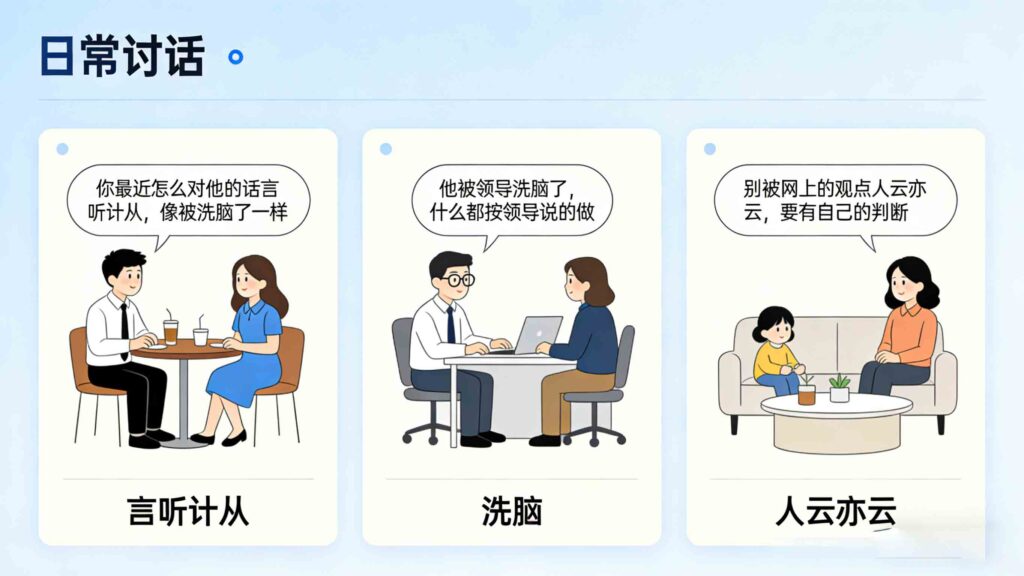
Now you know the key idioms. Here’s how to use them in daily life.
洗心革面 (Xǐ Xīn Gé Miàn): Use it for someone who changed their beliefs. Example: “After joining that group, he 洗心革面 (xǐ xīn gé miàn) and left his old friends.”
人云亦云 (Rén Yún Yì Yún): Use it to criticize blind following. Example: “Don’t be 人云亦云 (rén yún yì yún)—think for yourself.”
随波逐流 (Suí Bō Zhú Liú): Use it for someone who goes with the flow. Example: “She has no opinions; she just 随波逐流 (suí bō zhú liú).”
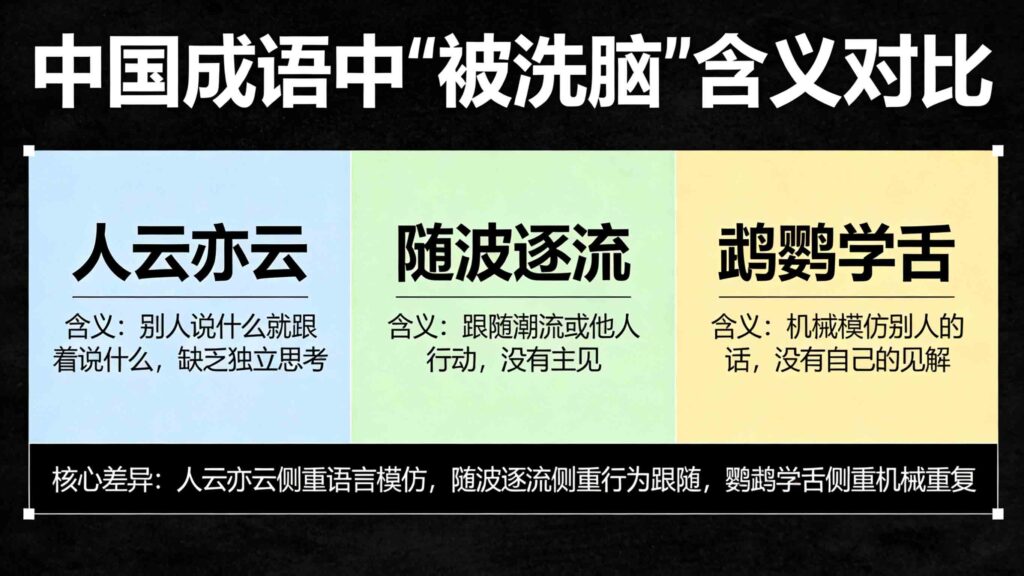
Key Differences Between These Idioms
All these idioms relate to “brainwashing.” But they have small differences.
洗心革面 (Xǐ Xīn Gé Miàn): Originally neutral (reform). Now used negatively for “brainwashing.”
人云亦云 (Rén Yún Yì Yún): Focuses on repeating others. No need for deliberate manipulation.
随波逐流 (Suí Bō Zhú Liú): Focuses on following trends. Not direct indoctrination.
Final Thoughts on Chinese Idioms Which Mean “Brainwashed”
Learning chinese idioms which mean brainwashed is more than just new words.
It helps you understand Chinese views on influence and independent thinking.
These idioms are rooted in history. They’re easy to remember with their stories.
They’ll help you communicate naturally in Mandarin.
Related Resources
Explore more guides to deepen your learning:
– Our premium 15 Classic Chinese Idiom Stories for Children (perfect for young learners).
– The 10 Popular Animal-Based Chinese Idioms guide (fun for all ages).
– For more details on Chinese idioms, visit the reliable linguistic resources.