Introduction
If you’ve ever struggled to understand Chinese conversations or texts—and wondered how to learn Chinese idioms to fill that gap—you’re not alone. Known as chéngyǔ (成语), these short, vivid phrases are everywhere in daily life—from chats with friends to movies, books, and even work meetings.
The good news is, how to learn Chinese idioms doesn’t have to be hard. This step-by-step guide is designed for foreign learners, breaking down simple, actionable methods to memorize, understand, and use Chinese idioms naturally—no complicated historical knowledge required.
Many foreign learners find Chinese idioms intimidating because they often have cultural roots or don’t translate literally. But with the right strategies, you can master them quickly and avoid common mistakes. By the end of this guide, you’ll know exactly how to learn Chinese idioms efficiently, and you’ll be able to use them in your own conversations with confidence.
Why Learning Chinese Idioms Matters (And Why It’s Easier Than You Think)
Before diving into how to learn Chinese idioms, let’s start with why they’re worth your time. Chinese idioms aren’t just “extra vocabulary”—they’re a key part of fluent Chinese communication. Here’s why they matter:
– They make you sound more natural: Native speakers use idioms constantly—learning them will help you blend in and avoid sounding like a textbook.
– They improve understanding: Most Chinese media (TV shows, social media, articles) uses idioms—without them, you’ll miss subtle meanings.
– They connect you to culture: Every idiom has a story (even simple ones!), and learning them helps you understand Chinese values and history.
The best part? You don’t need to memorize hundreds of idioms to see progress. Focus on the most common ones, use the right methods, and you’ll be on your way. Now, let’s get into the core: how to learn Chinese idioms step by step.
Step 1: Start with the Most Common Chinese Idioms (Not Rare Ones)
The biggest mistake foreign learners make when figuring out how to learn Chinese idioms is trying to memorize too many at once—especially rare, ancient ones. Instead, start with the 10-20 most common idioms you’ll actually hear in daily life. This way, you can practice using them right away, which makes memorization easier.
Here are 5 common Chinese idioms to start with (we’ll cover how to learn them below):
1. 一举两得 (yī jǔ liǎng dé) – Kill two birds with one stone
2. 一帆风顺 (yī fān fēng shùn) – Plain sailing / Go smoothly
3. 兴高采烈 (xìng gāo cǎi liè) – Be in high spirits
4. 闷闷不乐 (mèn mèn bù lè) – Be down in the dumps
5. 勤能补拙 (qín néng bǔ zhuō) – Hard work makes up for lack of talent
Step 2: Learn the Meaning (Not Just the Literal Translation)
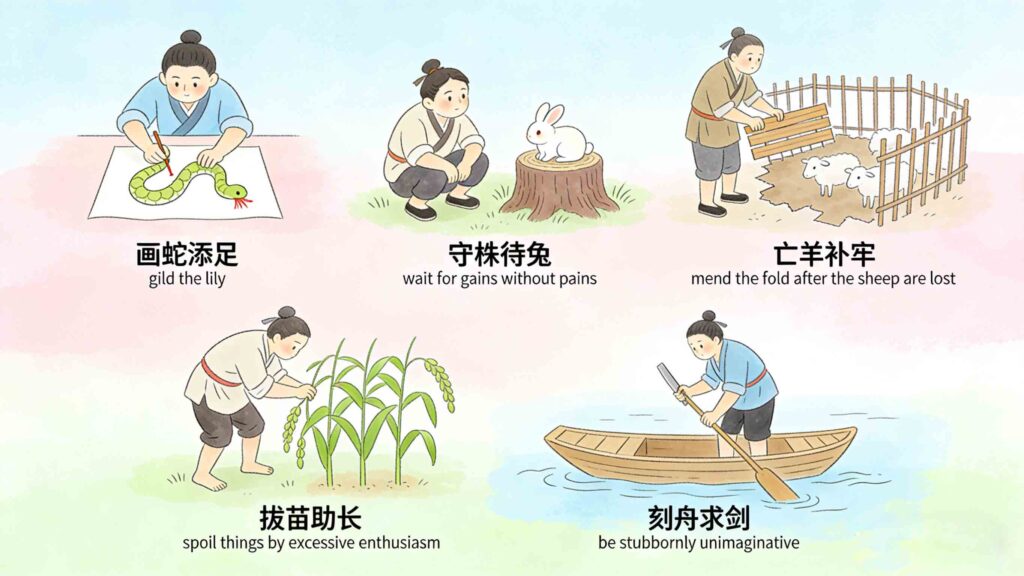
Another key to figuring out how to learn Chinese idioms is to focus on the actual meaning, not the literal words. Most Chinese idioms are made up of 4 characters, and their literal translation often doesn’t make sense. For example, 画蛇添足 (huà shé tiān zú) literally means “draw a snake and add feet,” but its real meaning is “to do something unnecessary that ruins the effect.”
How to do this: For each idiom, write down three things: the Chinese characters, Pinyin (pronunciation), and the natural English equivalent (not the literal translation). Avoid translating word for word—this will only confuse you later.
Step 3: Use Context to Remember (Examples Are Your Friend)
Memorizing idioms in isolation is hard—this is where many learners get stuck when trying to learn how to learn Chinese idioms. The best way to remember them is to use context: write down 1-2 simple example sentences for each idiom, in both Chinese and English.
Example for 一举两得 (yī jǔ liǎng dé):
– Chinese: 我每天早上跑步,既能锻炼身体,又能听播客,真是一举两得。(Wǒ měitiān zǎoshang pǎobù, jì néng duànliàn shēntǐ, yòu néng tīng bōkè, zhēn shì yī jǔ liǎng dé.)
– English: I run every morning—I can exercise and listen to podcasts at the same time; it’s killing two birds with one stone.
Practice saying these examples out loud—this helps your brain connect the idiom to a real situation, making it easier to remember and use later.
Step 4: Practice Daily (Even 5 Minutes a Day Works)
Consistency is key when it comes to how to learn Chinese idioms. You don’t need to spend hours every day—just 5-10 minutes of focused practice is enough. Here’s a simple daily routine:
1. Review 1-2 idioms you learned the day before (read the example sentences out loud).
2. Learn 1 new idiom (follow Steps 1-3 above).
3. Try to use 1 idiom in a sentence that day (even if it’s just talking to yourself!).
Over time, these small practice sessions will add up, and you’ll find yourself remembering idioms without even trying.
Step 5: Avoid Common Mistakes (Save Time and Embarrassment)
When learning how to learn Chinese idioms, avoiding common mistakes will help you progress faster and sound more natural. Here are the top mistakes foreign learners make, and how to fix them:
– Mistake 1: Using idioms too often – Native speakers use 1-2 idioms per conversation, not every sentence. Overusing them sounds unnatural.
– Mistake 2: Using the wrong tone – Some idioms are slightly negative (e.g., 井底之蛙 jǐng dǐ zhī wā = a person with narrow vision). Don’t use them to insult someone!
– Mistake 3: Forgetting pronunciation – Pinyin is important! If you mispronounce an idiom, native speakers might not understand you. Practice saying each idiom slowly at first.
Useful Tools to Make Learning Chinese Idioms Easier
You don’t have to learn how to learn Chinese idioms alone—there are plenty of tools to help you. Here are our top recommendations for foreign learners:
– Duolingo / Babbel: These apps have short lessons focused on common idioms and their usage.
– Quizlet: Create flashcards with idioms, Pinyin, and examples—great for quick reviews.
– BBC Learning Chinese: [External Link] A reliable resource for idiom lessons and cultural context (adds authority to your article).
– Our Guide to Common Chinese Idioms: [Internal Link] Check out our other guide for more common idioms to practice (adds internal link for SEO).
Final Tips: How to Learn Chinese Idioms Fast and Retain Them
To wrap up, here are a few extra tips to help you master how to learn Chinese idioms quickly and keep them in your memory:
– Learn the story behind simple idioms: Many common idioms have short, easy-to-remember stories (e.g., 卧薪尝胆 wò xīn cháng dǎn) — this makes them more memorable.
– Talk to native speakers: Practice using idioms with Chinese friends or language partners—they’ll correct you and help you use them naturally.
– Don’t give up: It’s normal to forget idioms at first—just keep reviewing and practicing, and you’ll get better.
Learning Chinese idioms is a fun and rewarding way to improve your Chinese skills and connect with Chinese culture. By following these steps, you’ll no longer wonder how to learn Chinese idioms—you’ll be doing it, and doing it well. Start with 1-2 idioms today, and soon you’ll be using them like a native!
If you want to start practicing right away, check out our 10 Common Chinese Idioms in English guide.
For more background on Chinese idioms (chéngyǔ), visit the Wikipedia page on Chengyu.