Writing is an art that thrives on precision, imagery, and cultural depth. Chinese idioms for writing (chéngyǔ) are not just linguistic flourishes—they are powerful tools that can transform your prose, adding layers of meaning, vivid imagery, and timeless wisdom to your work. Whether you’re crafting essays, stories, business reports, or creative content, mastering Chinese idioms for writing can help you convey complex ideas with elegance, capture your readers’ attention, and leave a lasting impression. This article explores the most practical and widely used Chinese idioms for writing, their meanings, and how to apply them to elevate your writing style.
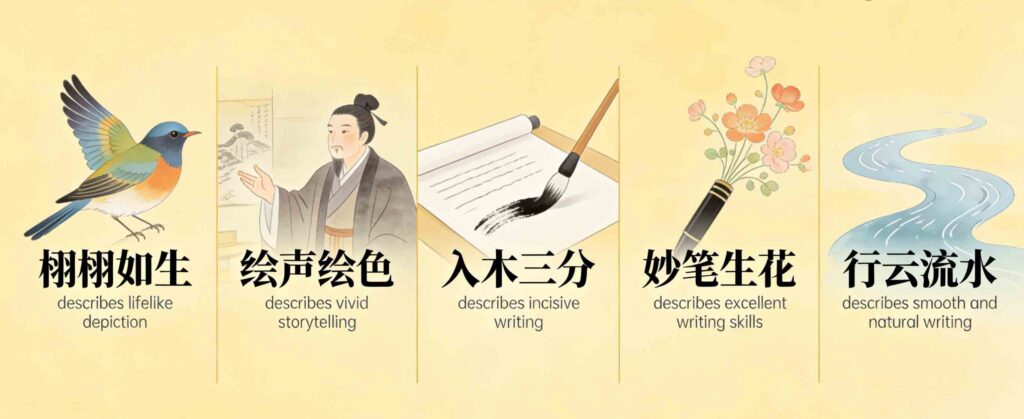
Why Chinese Idioms for Writing Are Essential
Chinese idioms for writing are deeply rooted in Chinese history, literature, and philosophy. They distill millennia of wisdom into concise, memorable phrases that can:
·Add vivid imagery and emotional depth to your writing, making it more engaging and memorable.
·Convey complex ideas and abstract concepts in a concise, impactful way, saving you from lengthy explanations.
·Infuse your prose with cultural richness and authority, positioning you as a thoughtful and knowledgeable writer.
·Create rhythm and flow in your sentences, enhancing the overall readability and beauty of your work.
For writers of all genres, Chinese idioms for writing are not just a nice-to-have—they are an essential part of crafting compelling, sophisticated prose. Below are the most essential idioms, categorized by common writing scenarios to make them easy to apply.
Chinese Idioms for Descriptive Writing
Descriptive writing aims to paint a picture with words, and Chinese idioms for writing are perfect for this task. These idioms can help you create vivid, sensory scenes that transport your readers to another world.
1. Yī cù yī xī (一草一木) – Every Blade of Grass and Every Tree
Pinyin: Yī cù yī xī
Literal Meaning: Every blade of grass and every tree.
Writing Application: This idiom is used to describe a scene in meticulous detail, emphasizing the importance of even the smallest elements.
Example: “She remembered the old courtyard with every yī cù yī xī, from the gnarled jujube tree to the moss-covered stone steps.”
2. Wàn zǐ qiān hóng (万紫千红) – A Profusion of Colors
Pinyin: Wàn zǐ qiān hóng
Literal Meaning: Ten thousand purples and a thousand reds.
Writing Application: This idiom vividly describes a scene of vibrant colors, often used to depict spring or a lively festival.
Example: “The garden bloomed in wàn zǐ qiān hóng, with peonies, roses, and lilies competing for attention under the golden sun.”
3. Rú shī rú huà (如诗如画) – As Poetic as a Painting
Pinyin: Rú shī rú huà
Literal Meaning: Like poetry, like a painting.
Writing Application: This idiom is used to describe a scene of extraordinary beauty, where reality feels like a work of art.
Example: “The mist-shrouded mountains and crystal-clear lake created a rú shī rú huà landscape that took her breath away.”
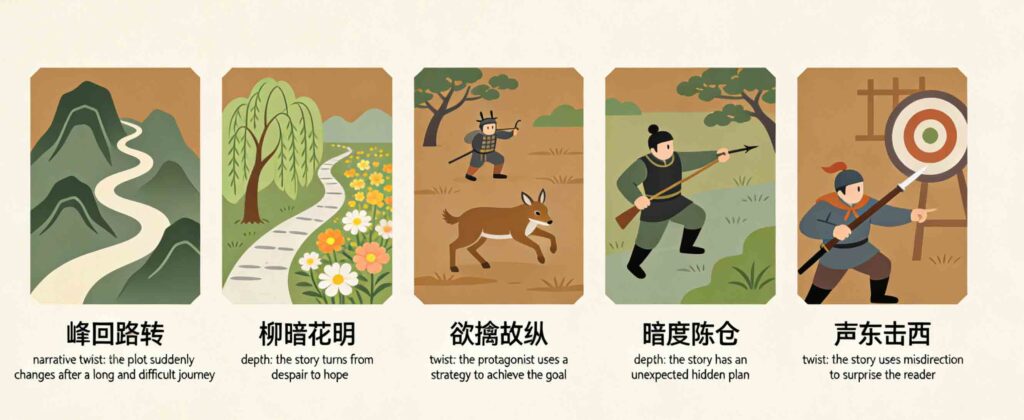
Chinese Idioms for Narrative Writing
Narrative writing tells a story, and Chinese idioms for writing can help you build tension, develop characters, and create a compelling plot.
1. Yī bō sān zhé (一波三折) – One Wave, Three Twists
Pinyin: Yī bō sān zhé
Literal Meaning: One wave, three twists and turns.
Writing Application: This idiom describes a story with many unexpected twists and turns, keeping readers engaged and guessing.
Example: “The detective novel was full of yī bō sān zhé, with each chapter revealing a new clue that turned the case on its head.”
2. Rú chū lóng zhī niǎo (如出笼之鸟) – Like a Bird Released from Its Cage
Pinyin: Rú chū lóng zhī niǎo
Literal Meaning: Like a bird released from its cage.
Writing Application: This idiom is used to describe a character’s sense of freedom and liberation after escaping a restrictive situation.
Example: “When she finally quit her soul-sucking job, she felt like rú chū lóng zhī niǎo, free to pursue her dreams of becoming a writer.”
3. Yī yán jiǔ dǐng (一言九鼎) – A Single Word Worth Nine Tripods
Pinyin: Yī yán jiǔ dǐng
Literal Meaning: One word, nine tripods (ancient symbols of power).
Writing Application: This idiom describes a character whose words carry immense weight and authority, often used to depict a wise leader or a trusted mentor.
Example: “The elder’s advice was yī yán jiǔ dǐng, and the villagers followed his guidance without hesitation.”
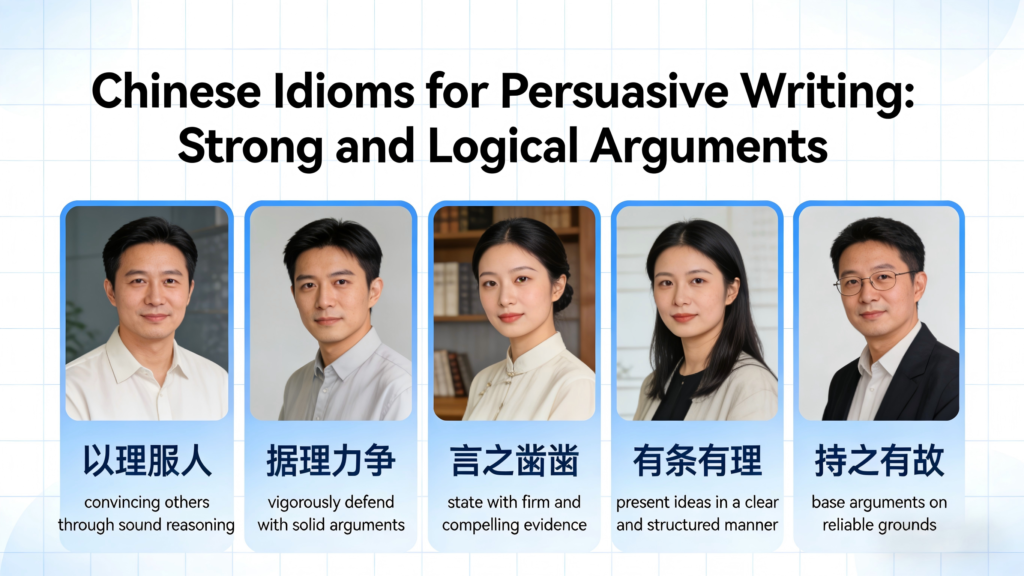
Chinese Idioms for Argumentative & Persuasive Writing
Argumentative and persuasive writing requires clarity, logic, and conviction. Chinese idioms for writing can help you strengthen your arguments, make your points more memorable, and persuade your readers.
1. Yī yī jiàn xuè (一针见血) – Get Straight to the Point
Pinyin: Yī yī jiàn xuè
Literal Meaning: One needle, one drop of blood.
Writing Application: This idiom is used to emphasize clarity and precision in your arguments, cutting through the noise to address the core issue.
Example: “The author’s critique was yī yī jiàn xuè, exposing the flaws in the government’s policy with unflinching honesty.”
2. Tiān yī wú fèng (天衣无缝) – Seamless as the Robes of Heaven
Pinyin: Tiān yī wú fèng
Literal Meaning: The robes of heaven have no seams.
Writing Application: This idiom describes an argument or narrative that is perfectly constructed, with no logical gaps or inconsistencies.
Example: “Her thesis was tiān yī wú fèng, weaving together evidence from history, sociology, and economics to support her thesis.”
3. Bǎi biàn bù yí (百辩不移) – Unshakable Through a Hundred Debates
Pinyin: Bǎi biàn bù yí
Literal Meaning: Unshakable through a hundred debates.
Writing Application: This idiom is used to describe a conviction or argument that is so strong it cannot be swayed, no matter how many counterarguments are presented.
Example: “The activist’s commitment to her cause was bǎi biàn bù yí, even in the face of fierce opposition and personal attacks.”
Tips for Using Chinese Idioms for Writing Effectively
To make the most of Chinese idioms for writing, keep these tips in mind:
First, understand the context: each idiom has a specific meaning and usage scenario. Make sure it fits the tone and purpose of your writing to avoid miscommunication.
Second, use them sparingly: while idioms are powerful, overusing them can make your writing seem forced or pretentious. Focus on quality over quantity, and only use an idiom when it truly enhances your prose.
Third, consider your audience: if you’re writing for non-Chinese readers, briefly explain the meaning of the idiom to ensure everyone understands. This also adds educational value to your work.
Finally, practice makes perfect: the more you use Chinese idioms for writing, the more natural and intuitive it will become. Start with a few key idioms and gradually expand your repertoire as you gain confidence.
Conclusion: Elevate Your Writing with Chinese Idioms
Chinese idioms for writing are more than just words—they are a window into Chinese culture and a powerful tool for crafting compelling, sophisticated prose. Whether you’re writing a novel, an essay, or a business report, these idioms can help you convey complex ideas with elegance, capture your readers’ attention, and leave a lasting impression. By mastering Chinese idioms for writing, you can elevate your writing style, deepen your connection with your readers, and achieve greater success as a writer.
If you want to master more advanced techniques and exclusive examples of using Chinese idioms for writing, check out our premium guide: Mastering Chengyu for Professional Writing: Unlock Your Creative Potential
For more background on the origin and cultural context of Chinese idioms, you can refer to the comprehensive entry on (Chengyu) on Wikipedia, a trusted source for linguistic and cultural information.