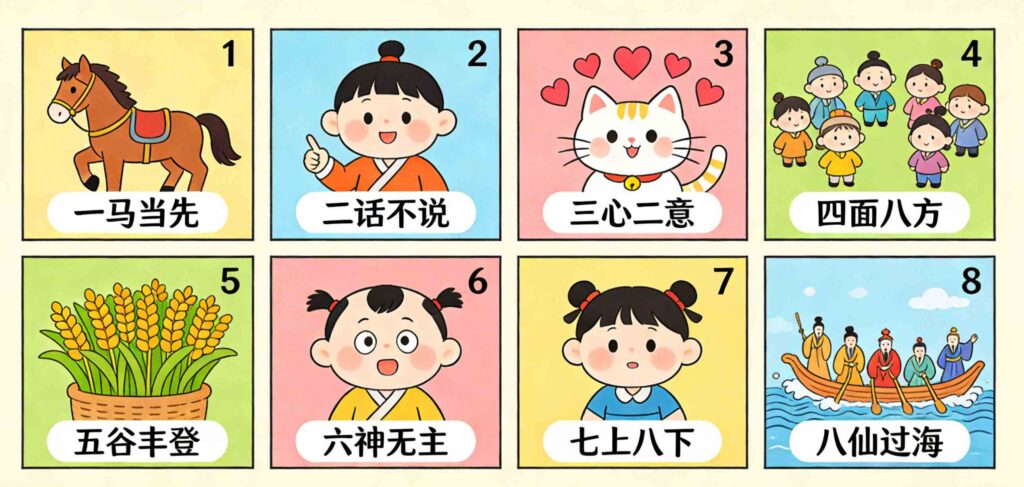
Chinese idioms with numbers are a charming part of the language, blending math, history, and wisdom into short, vivid phrases. These chengyu use digits to tell stories, teach morals, and paint pictures—making them perfect for learners and culture lovers alike. Below are 8 of the most popular Chinese idioms with numbers, complete with their stories and meanings.
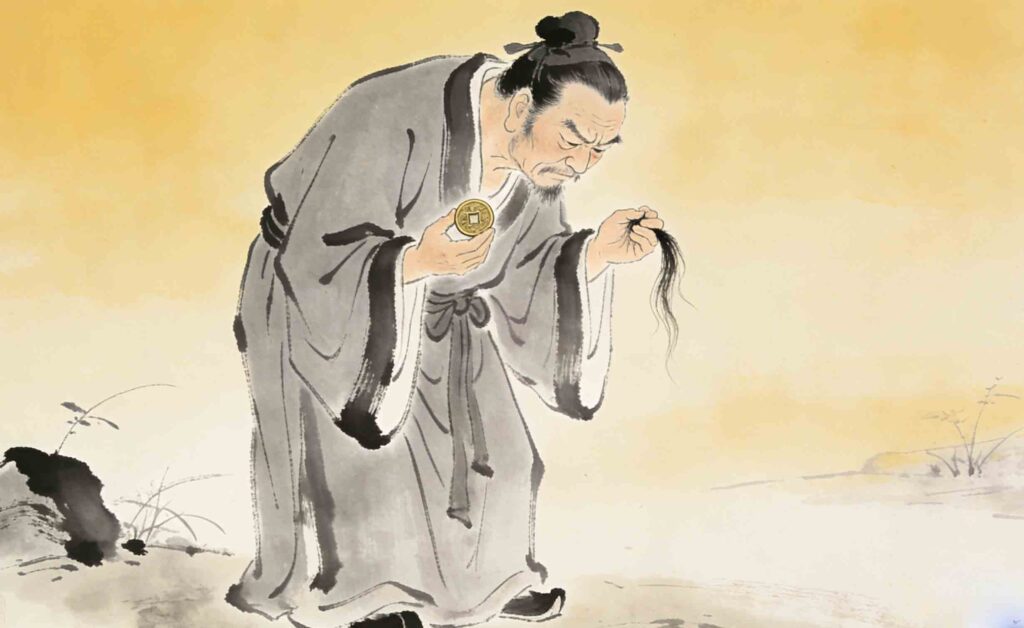
1. Yi Mao Yi Wen (一毛一文) – A Chinese Idiom with Numbers About Stinginess
Meaning: To be extremely stingy or miserly; unwilling to spend even the smallest amount of money.
Story: A rich man was so greedy that he refused to give away a single hair from his head or a single coin from his purse. When a friend asked for help, he replied, “I would not give a single hair or a single coin to anyone.” The idiom now describes people who are overly careful with their money.
Usage Example: “My uncle is yi mao yi shi—he never buys anyone a drink, even on his birthday.”
2. Liang Quan Qi Mei (两全其美) – Satisfying Both Sides
Meaning: To find a solution that benefits everyone involved; a win-win situation.
Story: A man had two sons who wanted to inherit his land. Instead of splitting the land, he found a way to let both sons use it fairly: one farmed the fields, and the other managed the harvest. Both were happy, and the idiom was born to praise this kind of compromise.
Usage Example: “Working from home is liang quan qi mei—it saves time and helps me balance work and family.”
3. San Tou Liu Bi (三头六臂) – A Powerful Chinese Idiom with Numbers
Meaning: To have extraordinary abilities or superhuman power; to be able to handle many tasks at once.
Story: This idiom comes from Chinese mythology, where the god Nezha is depicted with three heads and six arms, allowing him to fight multiple enemies at once. Today, it describes people who are incredibly capable and can juggle many responsibilities.
Usage Example: “My boss thinks she has san tou liu bi—she’s always taking on 10 projects at once.”
4. Si Mian Chu Ge (四面楚歌) – Chu Songs from All Sides
Meaning: To be surrounded by enemies or difficulties; to be in a hopeless situation.
Story: During the Chu-Han War, Liu Bang’s army surrounded Xiang Yu’s forces. They sang Chu folk songs at night, making Xiang Yu’s soldiers homesick and demoralized. Many deserted, and Xiang Yu was defeated. The idiom describes being trapped with no way out.
Usage Example: “After the company lost its main clients, the team felt like they were si mian chu ge.”
5. Wu Hua Ba Men (五花八门) – A Colorful Chinese Idiom with Numbers
Meaning: A wide variety of things; diverse and colorful.
Story: Originally, this idiom referred to the “five flowers” (different types of soldiers) and “eight gates” (different martial arts styles) in ancient Chinese armies. Over time, it came to mean any collection of varied or eclectic items.
Usage Example: “The night market has wu hua ba men snacks—from sweet dumplings to spicy noodles.”
6. Liu Shen Wu Zhu (六神无主) – The Six Spirits Have No Master
Meaning: To be confused, flustered, or at a loss for what to do.
Story: In traditional Chinese medicine, there are “six spirits” that govern the body’s emotions. When these spirits are unmoored, a person feels disoriented and unable to think clearly. The idiom is used to describe someone who is panicking or overwhelmed.
Usage Example: “When I lost my passport, I was liu shen wu zhu—I didn’t know who to call first.”
7. Qi Shang Ba Xia (七上八下) – A Popular Chinese Idiom with Numbers
Meaning: To be anxious or nervous; to have a fluttering feeling in one’s stomach.
Story: This idiom uses the numbers 7 and 8 to mimic the feeling of a heart jumping up and down. It’s often used to describe the nervousness before an important event, like a test or a job interview.
Usage Example: “I was qi shang ba xia before my first public speech.”

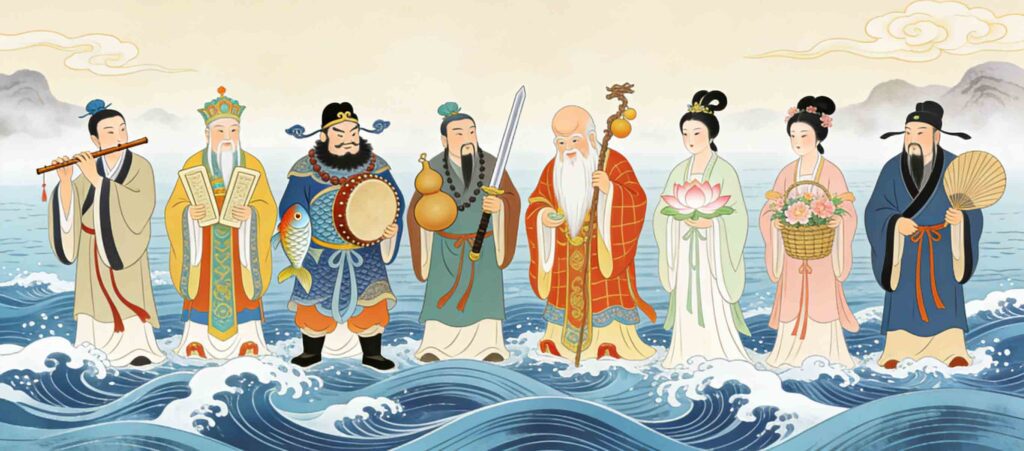
8. Ba Xian Guo Hai (八仙过海) – The Eight Immortals Cross the Sea
Meaning: Each person uses their own unique skills to achieve a goal; “each to their own.”
Story: The Eight Immortals were traveling across the East China Sea. Instead of taking a boat, each used their magical item to cross: one rode a gourd, another a fan, another a lotus flower. The idiom celebrates diversity and individual talent.
Usage Example: “In our group project, we worked ba xian guo hai—each person used their strengths to finish the task.”
Why Chinese Idioms with Numbers Are Special
Chinese idioms with numbers are more than just phrases—they are a window into Chinese culture. Numbers in Chinese often carry symbolic meanings (like 8 for luck and 4 for bad luck), and these idioms weave those meanings into stories that have been told for thousands of years. For language learners, they are a fun way to practice numbers and learn about Chinese history at the same time.
More Chinese Idiom Stories
If you enjoy these number-themed idioms, you can explore more:
- 15 Fun Chinese Idiom Stories for Children
- 10 Inspirational Idioms About Diligence and Hard Work
- 10 Vivid Chinese Idioms Related to Animals
For more authoritative information about Chinese idioms, you can refer to the relevant introduction on Wikipedia: Chengyu.
1 thought on “Chinese Idioms with Numbers: 8 Fun Chengyu with Stories”