Family is the core of traditional Chinese culture, and Chinese idioms about family are the best way to learn its deep values of filial piety and home warmth.
They are called chengyu—fixed phrases with deep moral values and vivid stories.
They let you understand Chinese family ethics easily.
Below are 7 meaningful Chinese idioms about family.
Each has a touching story, clear meaning, and real-life usage.
We’ve also paired them with suitable illustrations to bring the tales to life.
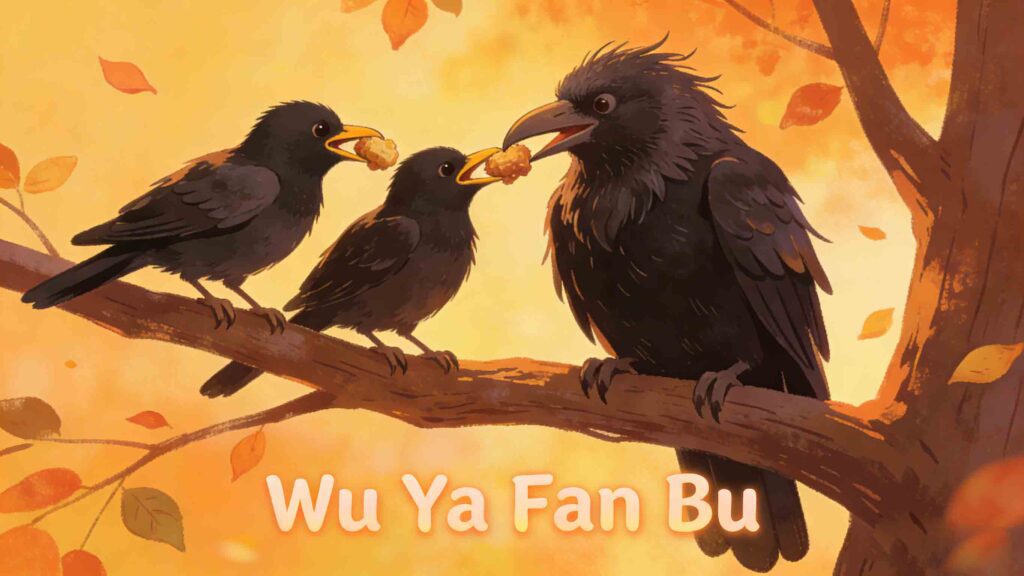
1. 乌鸦反哺 (Wū Yā Fǎn Bǔ) – The Crow Feeds Its Mother
Meaning: Repay your parents when they grow old.
It’s a core expression of filial piety.
Children should care for elderly parents, just as parents raised them.
Story: This idiom comes from an ancient folk tale about crows.
Crows are deeply linked to family devotion in Chinese culture.
When young crows are small, their mother hunts day and night to feed them.
She protects them until they can fly and find food on their own.
When the mother crow grows old and weak, the grown chicks don’t abandon her.
They take turns finding food and feeding her with care.
This behavior became a symbol of filial piety.
It teaches people to be grateful and care for their parents.
Usage Example: As an adult, he quit his busy city job.
He returned home to take care of his sick parents.
He lived out the spirit of wu ya fan bu.
2. 卧冰求鲤 (Wò Bīng Qiú Lǐ) – Lying on Ice to Pray for Carp
Meaning: Extreme filial piety.
Willing to endure great hardship to fulfill parents’ wishes.
It’s a classic story from the “Twenty-Four Filial Exemplars.”
Story: The story dates back to the Jin Dynasty.
It centers on a boy named Wang Xiang.
His mother died when he was young.
His stepmother was not kind to him, but he still respected her.
One cold winter, his stepmother fell ill.
She craved fresh carp to eat.
All rivers and lakes were frozen solid—no one could catch fish.
Wang Xiang took off his thick clothes.
He lay bare-chested on the ice to melt it with his body warmth.
Moved by his filial piety, the ice cracked open.
Two lively carp jumped out.
Wang Xiang brought the fish home to cook for his stepmother.
His devotion has been praised for thousands of years.
Usage Example: She cares for her elderly parents no matter how hard it is.
Her dedication is just like wo bing qiu li.
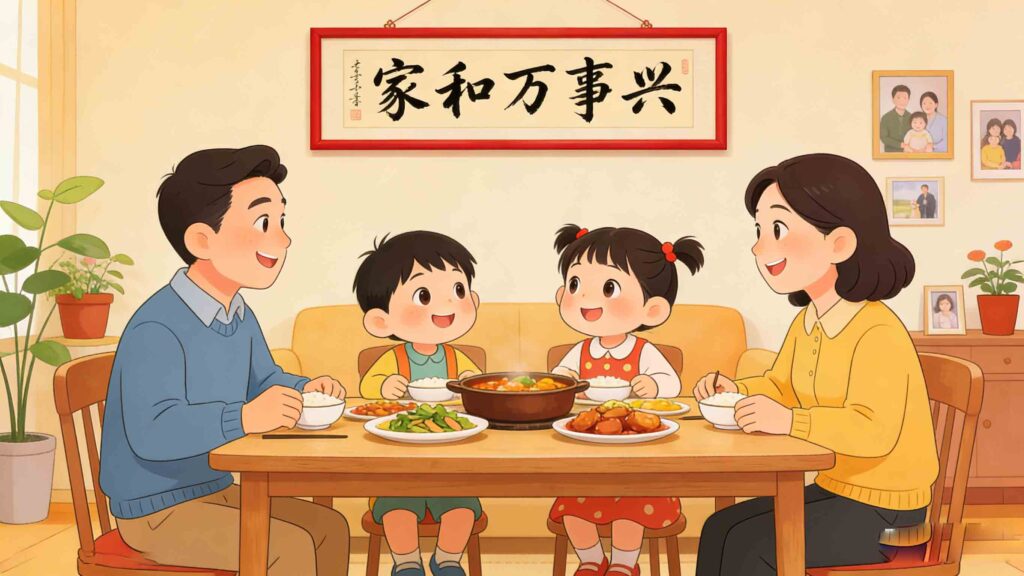
3. 家和万事兴 (Jiā Hé Wàn Shì Xīng) – A Harmonious Family Leads to Prosperity
Meaning: A harmonious family brings smoothness and prosperity.
If family members are united and conflict-free, all things will go well.
It’s the most widely used Chinese idiom about family harmony.
Story: This idiom is not tied to a single historical figure.
It’s a universal truth from ancient Chinese life experience.
In traditional China, family is the foundation of social order.
Harmony between family members is the source of good fortune.
Ancient families believed quarrels bring decline.
Mutual understanding and support make families thrive.
It’s often pasted on family doors during festivals.
It represents a simple wish for family happiness.
Usage Example: We try to understand each other and avoid arguments.
We know jia he wan shi xing is key to a happy family.
4. 手足情深 (Shǒu Zú Qíng Shēn) – Deep Brotherly Love
Meaning: The deep bond between brothers (and sisters).
It’s like the relationship between hands and feet— inseparable.
It describes close sibling affection and mutual support.
Story: Ancient Chinese people saw brothers as lifelong companions.
Sibling harmony was a key family virtue.
This idiom compares brothers to hands and feet.
They rely on each other to overcome difficulties.
There’s a classic story of two brothers facing poverty together.
They never left each other’s side.
When one was in trouble, the other helped at all costs.
Their bond became a model for sibling love.
The idiom spread to praise this precious family tie.
Usage Example: They live far apart now.
But the two brothers still keep in close touch.
They help each other, showing true shou zu qing shen.
5. 承欢膝下 (Chéng Huān Xī Xià) – Enjoying Family Joy by Parents’ Side
Meaning: Stay by your parents’ side when they are old.
Bring them joy and accompany them in their later years.
It’s a warm idiom about filial companionship.
Story: In ancient China, most people lived in extended families.
Children were expected to stay close to their parents.
They needed to care for and accompany their parents.
“Xi xia” means the area under parents’ knees.
It symbolizes being near them and spending time together.
This idiom describes a warm scene.
Children chat with parents, help with housework, and share daily life.
This makes the elderly feel loved and not lonely.
It focuses on ordinary, daily companionship— the most touching family love.
Usage Example: She chose to work close to home.
This way, she could cheng huan xi xia.
She could spend more time with her aging parents.
6. 父慈子孝 (Fù Cí Zǐ Xiào) – Father Kind, Son Filial
Meaning: A perfect parent-child relationship.
Parents are kind to their children.
Children are filial and respectful to their parents.
It’s a core ideal of Chinese family ethics.
Story: This idiom comes from ancient Confucian teachings.
It emphasizes family virtue is two-way.
It doesn’t just require children to be filial.
It also requires parents to be kind and responsible.
In a healthy family, love is mutual.
Parents raise children with care and teach good virtues.
In return, children respect parents and take care of them in old age.
This mutual love is the foundation of a happy family.
It has guided generations to build harmonious parent-child relationships.
Usage Example: Their family has a happy atmosphere.
It’s full of fu ci zi xiao.
Parents and children get along like friends.
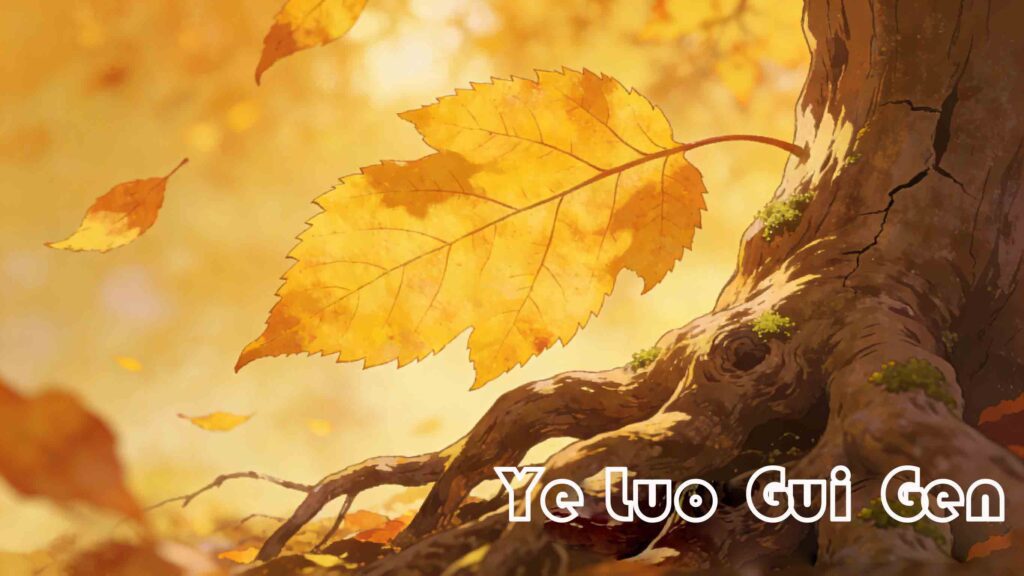
7. 叶落归根 (Yè Luò Guī Gēn) – Leaves Fall Back to Their Roots
Meaning: No matter how far you wander, you’ll return home.
Your family and hometown are your roots.
It describes nostalgia for family and birthplace.
Story: This idiom uses a natural phenomenon to symbolize family feelings.
Leaves grow on branches.
In autumn, they wither and fall back to the tree’s roots.
People also have an innate attachment to family and hometown.
In ancient times, many people left home to study or work.
They lived far away for decades.
But they always hoped to return home.
They wanted to reunite with family and spend their later years there.
This idiom shows that family and hometown are eternal roots.
Usage Example: He worked abroad for 20 years.
He finally retired and returned to his hometown.
He reunited with his family, fulfilling ye luo gui gen.
Why Chinese Idioms About Family Are Important
Chinese idioms about family are more than just words.
They are the essence of Chinese family culture.
They pass down filial piety, harmony, and gratitude.
Each idiom tells a touching story.
It reflects the universal value of cherishing family bonds.
For Chinese learners, these idioms show Chinese family ethics deeply.
More Related Chinese Idiom Stories
- 15 Fun Chinese Idiom Stories for Children
- 10 Inspirational Idioms About Diligence and Hard Work
- Chinese Idioms with Numbers: Classic Chengyu with Interesting Stories
For more authoritative info on Chinese idioms, visit:Wikipedia: Chengyu