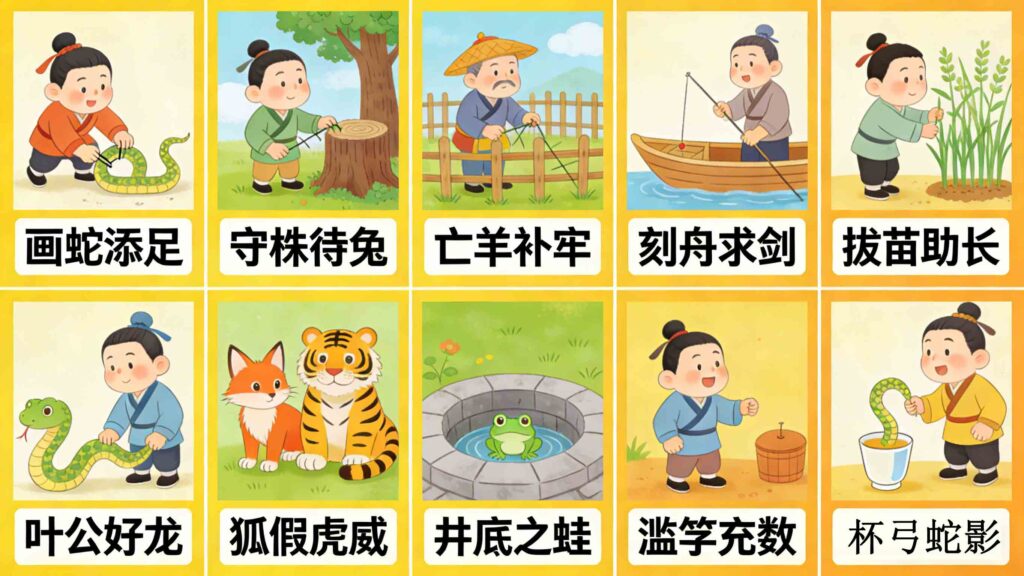
Famous Chinese idioms are more than just phrases—they are windows into China’s 5,000-year history, culture, and wisdom. These concise, vivid expressions are used daily in conversations, speeches, and writing, making them essential for anyone learning Chinese or exploring Chinese culture.
1. Yi Mu Liao Ran (一目了然) – One of the Most Famous Chinese Idioms for Clarity
Meaning: To understand something completely at first sight; obvious and easy to see.
Story: This idiom comes from ancient scholars describing clear handwriting and well-organized texts. Unlike messy bamboo slips, a neat document let readers grasp the meaning instantly. Today, it describes anything clear and straightforward, like a well-designed map or simple instructions.
Usage Example: “The new app interface is yi mu liao ran—even a child can use it.”
2. Zou Ma Guan Hua (走马观花) – A Famous Chinese Idiom About Superficial Observation
Meaning: To look at something hastily or superficially; to skim the surface without deep understanding.
Story: A long time ago, a man rode a horse quickly past a garden of beautiful flowers. He only caught a quick glimpse and could not remember the details of the blooms. The idiom now criticizes shallow observation or rushed learning.
Usage Example: “Tourists often just zou ma guan hua when visiting the Forbidden City, missing its hidden stories.”
3. Shou Zhu Dai Tu (守株待兔) – A Famous Chinese Idiom Warning Against Laziness
Meaning: To wait for luck instead of taking action; to rely on chance without effort.
Story: A farmer once saw a rabbit run into a tree stump and die. He stopped working and sat by the stump every day, waiting for more rabbits to come. He got nothing and his fields grew wild. This idiom warns against laziness and blind hope.
Usage Example: “You can’t just shou zhu dai tu for a promotion—you have to work hard.”

4. Jing Gong Zhi Niao (惊弓之鸟) – A Famous Chinese Idiom About Fear
Meaning: To be extremely nervous or easily scared by small things, due to past trauma.
Story: A general shot a bow without an arrow, and a bird fell from the sky. The bird had been wounded by a bow before, so the sound of the bowstring made it panic and lose strength. The idiom describes people who are overly cautious or jumpy.
Usage Example: “After the accident, he became a jing gong zhi niao, afraid of every loud noise.”
5. Ke Zhou Qiu Jian (刻舟求剑) – A Famous Chinese Idiom About Rigidity
Meaning: To be stubborn and inflexible; to use outdated methods for changing situations.
Story: A man dropped his sword into a river while crossing in a boat. He carved a mark on the boat’s side, saying, “This is where my sword fell.” When the boat stopped, he jumped into the water at the mark to look for the sword, but it was gone. The idiom mocks rigid thinking.
Usage Example: “Using old business strategies now is like ke zhou qiu jian—they won’t work in the modern market.”
6. Wang Mei Zhi Ke (望梅止渴) – Looking at Plums to Quench Thirst
Meaning: To comfort oneself with false hope or illusions; to use mental tricks to ease hardship.
Story: During a war, Cao Cao’s army was thirsty and tired. He pointed to a distant plum grove and said, “The plums there are sweet and sour—they will quench your thirst!” The soldiers’ mouths watered, and they kept marching until they found water. The idiom describes using imagination to boost morale.
Usage Example: “We talked about our vacation plans to wang mei zhi ke during the long work week.”
7. Hua Long Dian Jing (画龙点睛) – Adding the Finishing Touch to a Dragon Painting
Meaning: To add the final, most important detail that makes something perfect; the highlight of a work.
Story: An artist painted four dragons on a wall but left out their eyes. People asked why, and he said, “If I add the eyes, the dragons will fly away.” When he painted the eyes on two dragons, thunder struck, and the dragons flew into the sky. The remaining two, without eyes, stayed on the wall.
Usage Example: “The final quote in her speech was hua long dian jing—it made the whole presentation unforgettable.”
8. Si Mian Chu Ge (四面楚歌) – Chu Songs from All Sides
Meaning: To be surrounded by enemies or difficulties; to be in a hopeless situation.
Story: During the Chu-Han War, Liu Bang’s army surrounded Xiang Yu’s forces. They sang Chu folk songs at night, making Xiang Yu’s soldiers homesick and demoralized. Many deserted, and Xiang Yu was defeated. The idiom describes being trapped with no way out.
Usage Example: “After the company lost its main clients, the team felt like they were si mian chu ge.”
9. Ba Xian Guo Hai (八仙过海) – The Eight Immortals Cross the Sea
Meaning: Each person uses their own unique skills to achieve a goal; “each to their own.”
Story: The Eight Immortals were traveling across the East China Sea. Instead of taking a boat, each used their magical item to cross: one rode a gourd, another a fan, another a lotus flower. The idiom celebrates diversity and individual talent.
Usage Example: “In our group project, we worked ba xian guo hai—each person used their strengths to finish the task.”
10. Kuang Heng Zao Bi Tou Guang (匡衡凿壁偷光) – Boring a Hole to Steal Light
Meaning: To study hard despite poverty and hardship; to be dedicated to learning.
Story: Kuang Heng was a poor boy who loved reading but had no light at night. He bored a small hole in his wall to let in his neighbor’s candlelight, and read by that tiny beam every night. He later became a famous scholar. The idiom praises perseverance and love of learning.
Usage Example: “Students who study late into the night show the same spirit as Kuang Heng zao bi tou guang.”

Why Famous Chinese Idioms Are Essential to Chinese Culture
Famous Chinese idioms are not just linguistic tools—they carry the values and stories of Chinese culture. They teach us about hard work, wisdom, flexibility, and resilience. For language learners, mastering these idioms is key to understanding native speakers and expressing ideas vividly.
Final Thoughts on These Famous Chinese Idioms
These 10 famous Chinese idioms are the most widely used and loved in modern Chinese. Each has a rich story and a clear moral, making them easy to remember and fun to use. Whether you’re learning Chinese or just curious about culture, these idioms are a perfect starting point to explore the beauty of the Chinese language.
More Interesting Chinese Idiom Stories
If you enjoy these classic idioms, you can continue reading more related stories to enrich your understanding of traditional Chinese culture.
- 15 Fun Chinese Idiom Stories for Children
- 10 Inspirational Idioms About Diligence and Hard Work
- 10 Vivid Chinese Idioms Related to Animals
For more authoritative information about the origin and cultural background of Chinese idioms, you can refer to the relevant introduction on Wikipedia.